
Toronto’s Art Scene after Painters Eleven
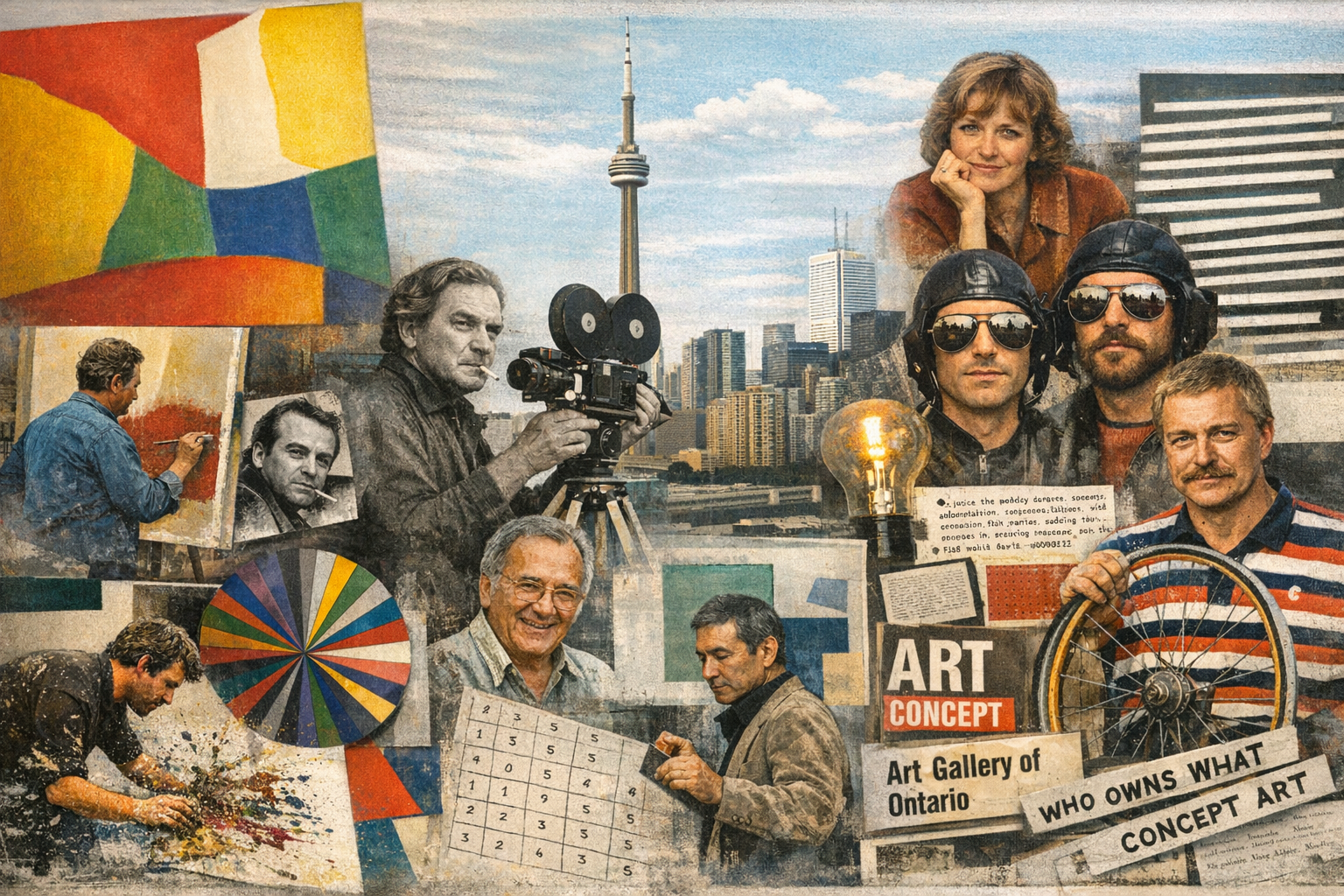
After the Dam Broke: Toronto’s Defining Decades (1960s–1970s)
After the disbanding of Painters Eleven in 1960, Toronto’s art scene entered a period of rapid diversification and debate. Abstraction was no longer the issue — how to move beyond it was. The group had broken the dam. What followed was an explosion of competing ideas about form, meaning, and the role of the artist in society.
By the early 1960s, abstraction was firmly accepted within major institutions, commercial galleries, and universities. The argument shifted from whether abstract art belonged in Canada to what kind of abstraction mattered. Artists debated intuition versus structure, emotion versus systems, painterly gesture versus controlled form.
One direction leaned toward colour-field and lyrical abstraction, extending the legacy of Painters Eleven while refining it.
Refinement and Expansion: The Abstract Continuum
Jack Bush became the clearest international success story of this lineage. Moving confidently into Color Field painting, Bush developed expansive compositions defined by heightened colour clarity and spatial openness. His career formed a crucial bridge between Toronto and New York, proving that a Canadian painter could shape — not merely follow — modernist discourse.
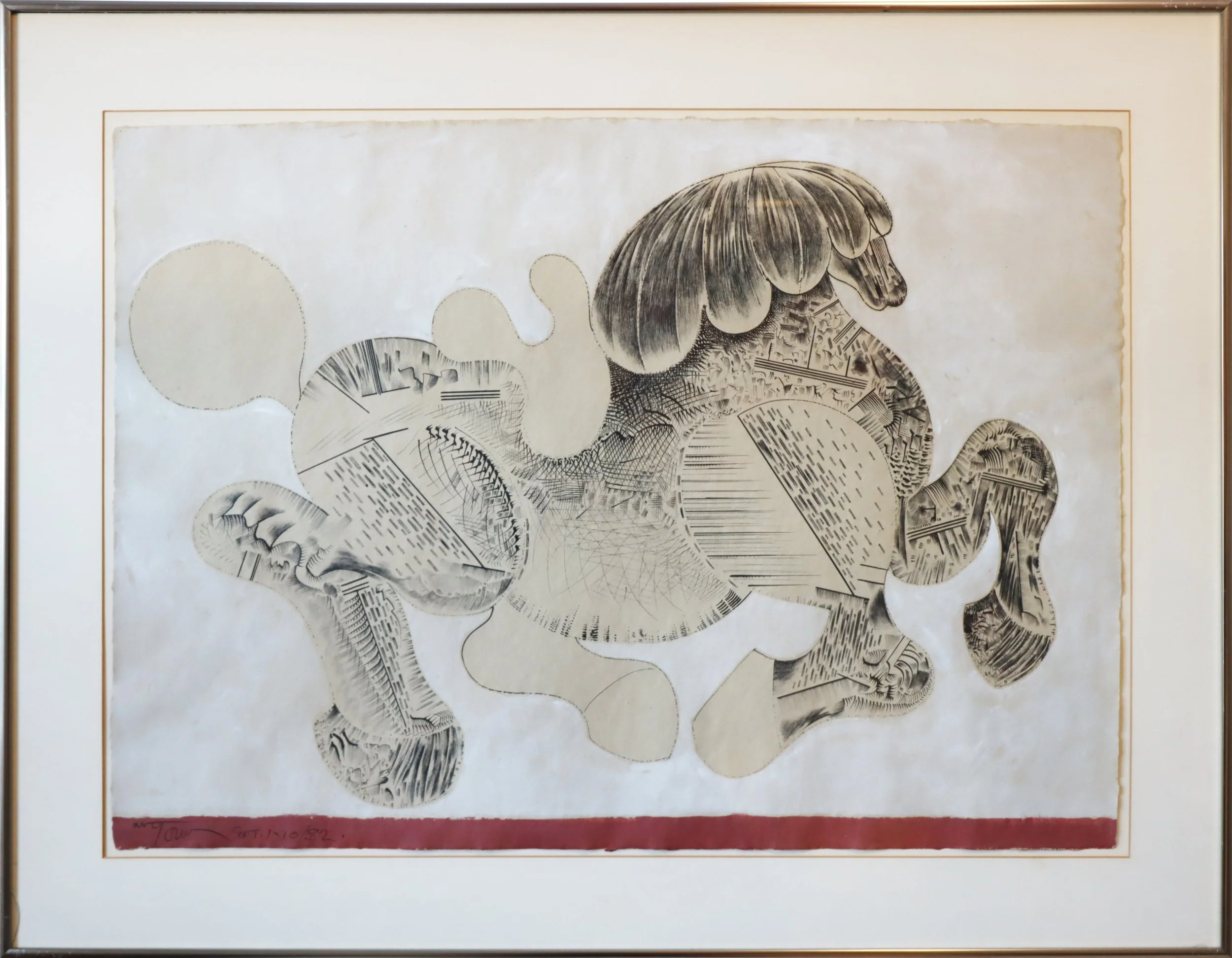
restless and prolific, pushed abstraction through cycles of reinvention: automatic drawing, collage, graphic compression, and bold painterly surfaces. His work embodied the tension between instinct and control that defined the decade.
Harold Town. Toy Horse #265,1982 mixed media 22 1/8" x 30 1/2" POR
William Ronald, outspoken and controversial, relocated to New York and became a vocal advocate for modernism, reinforcing the international ambitions of Toronto artists.
Meanwhile,
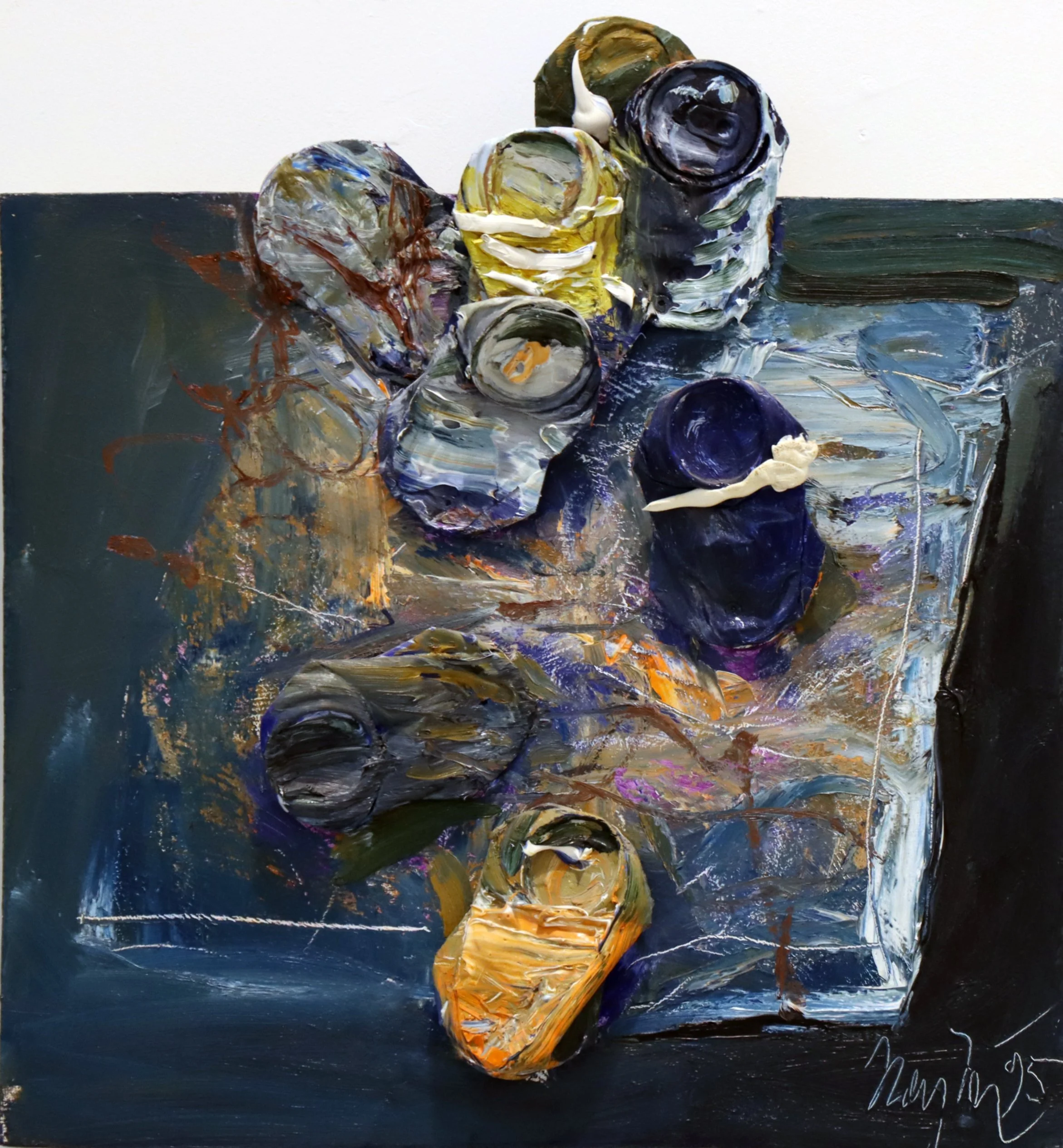
Gordon Rayner shifted abstraction toward something raw and materially charged. His emphasis on surface, gesture, and physical process influenced younger artists seeking immediacy over polish.
Gordon Rayner. Pub Table #2, 1995 oil on board with aluminum 21" x 20" x 3" $8,500
Abstraction did not disappear — it evolved. It became leaner, more chromatic, more self-aware.
Hard-Edge, Systems, and the Rise of Analytical Art
At the same time, Toronto artists were increasingly aware of developments in hard-edge abstraction, minimalism, and conceptual thinking emerging from the United States and Europe. A more analytical, idea-driven approach took hold. Geometry, systems, repetition, and reduction challenged the emotional intensity associated with Abstract Expressionism.
Though based in Montreal, Claude Tousignant exerted a strong influence through his optical discs and chromatic precision, emphasizing perception over expression.
Kazuo Nakamura turned toward mathematics and universal order. Numerical sequences, grids, and repetition became central to his search for structure beneath surface complexity.
Roy Kiyooka explored geometry and perceptual experience before expanding into photography and poetry, foreshadowing the collapse of strict medium boundaries.
And with conceptual wit, Iain Baxter& (later Iain Baxter) challenged conventional definitions of the art object itself. His work bridged object, system, and idea — suggesting that art might reside as much in language and context as in material form.
Painting was no longer the unquestioned center. It was one option among many.
The Real Rupture: Conceptual Art and Institutional Critique
By the late 1960s, Toronto had become a center for conceptual experimentation. Artists associated with institutions such as the Art Gallery of Ontario, NSCAD University, and emerging artist-run spaces began questioning authorship, language, and theory. Art was no longer only about visual experience — it was about ideas, context, and critique.
Michael Snow became internationally significant through film, sound, sculpture, and installation. His landmark film Wavelength redefined cinematic structure and positioned Canadian conceptual practice within global discourse.
Joyce Wieland brought feminist politics, nationalism, and experimental craft into contemporary art conversations, challenging institutional hierarchies while expanding artistic language.
The collective General Idea — comprised of AA Bronson, Felix Partz, and Jorge Zontal — reshaped Canadian contemporary art through media critique, irony, and strategic self-mythologizing. Their work anticipated postmodern strategies long before the term became widespread.
Though based in London, Ontario, Greg Curnoe exerted major influence in Toronto. His regionalism and skepticism toward American dominance asserted that local identity could coexist with avant-garde experimentation.

Drawing from London School artists,
Ron Martin also belonged to this broader intellectual current.
His process-driven, serial abstraction redefined painting as a performance of material and perception, contributing to Toronto’s expanding conceptual dialogue during this period.
Ron Martin. No Title #14, Dec. 1976 acrylic on canvas 78" x 84" POR
A Culture of Productive Tension
This era was marked by productive friction: painters versus conceptualists, intuition versus intellect, international influence versus local identity.
What Painters Eleven ultimately secured was not a single successor style, but something more powerful — a culture of openness and argument. Their greatest legacy was not abstraction itself, but the freedom to debate, evolve, and redefine art on Canadian terms.
By the end of the 1970s, Toronto had emerged not as a follower, but as a serious, internationally engaged art center — shaped less by consensus than by conviction.
The dam had broken. What flowed out was complexity.
What Our Readers Say
〰️
What Our Readers Say 〰️
Hello you two, Thanks for another informative post. It was like taking a walk through the Mann Gallery. “Organized me” liked Martin’s Eye Series and Bocour Green, (2,8,32,128). I continue to enjoy Clements urban studies, a landscape I appreciate and Tom Mathew’s Ice Reflection is so wonderful. When I win the lottery I will purchase his work.
Take care and much success,
Janice Low
well done Paige and Margie!!
jd (Joseph Drapell)
