
Toy Horse #265, 1982
Harold Town


Artist: Harold Town
Title: Toy Horse #265, 1982
Media: Pen, ink, acrylic, barcham green, 1969 De Witt
Size: 22 1/8” x 30 1/2”
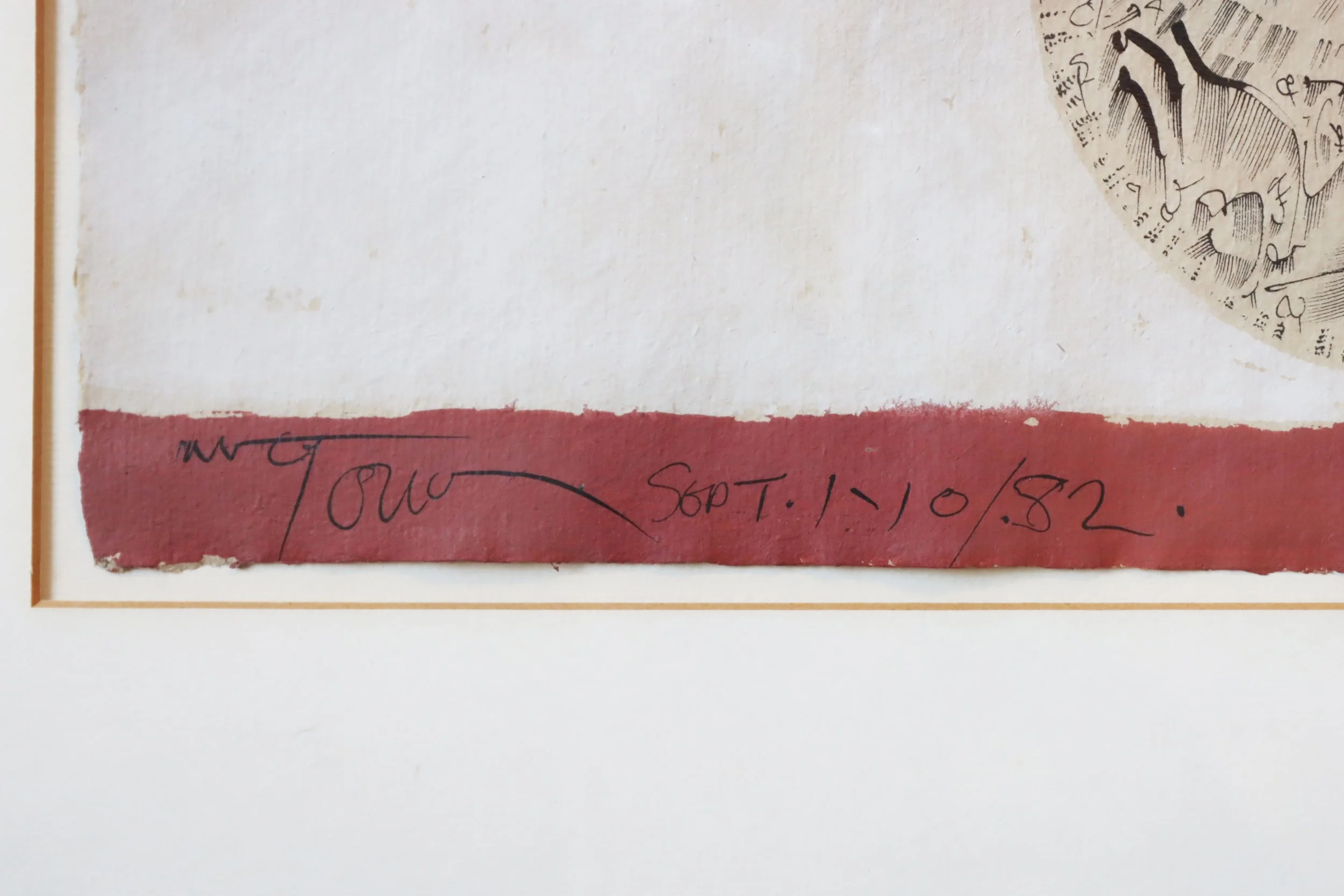
Notes: signed and dated lower left, work on paper framed
Provenance:
Mann Collection, St. Catharines, ON since 1986
Moore Gallery, Hamilton, ON
Artist’s studio
Exhibited at Moore Gallery, Hamilton, ON
The John Mann Gallery, St. Catharines, ON
Description: Town’s Toy Horse series, produced primarily during the 1970s and 1980s, is one of the most recognizable and celebrated bodies of work from his later career. Inspired by an antique rocking horse gifted to him by scholar Iris Nowell, Town returned to the motif repeatedly, creating dozens of inventive variations in ink, gouache, and acrylic on paper. The series reflects his playful engagement with figurative imagery, transforming the familiar toy horse into a dynamic subject rich in movement, pattern, and graphic energy.
Created during his years at Old Orchard Farm near Peterborough, Ontario, the Toy Horse works mark a significant shift from Town’s earlier abstract expressionism toward a more figurative, pop-inflected approach. Bold colour, confident line, and rhythmic composition define the series, which is widely regarded as his most successful late figurative body of work. Today, Toy Horse drawings remain highly sought after by collectors and continue to play an important role in Town’s legacy within Canadian art history.
Collector’s Note: Harold Town’s market reflects his importance as a foundational figure in Canadian postwar abstraction and a co-founder of Painters Eleven. Collector interest is strongest in works from the mid-1950s to early 1960s, particularly his gestural abstract paintings and his innovative “single autographic prints,” which are one-of-a-kind works and among the most historically significant prints produced in Canada during this period.
Paintings from Town’s early abstract years consistently command the highest prices, as they align with the breakthrough moment when abstraction entered the Canadian mainstream. These works are frequently sought by collectors building serious holdings in Canadian modernism or Painters Eleven, where Town serves as a key anchor artist.
Later works, including collage-based and pop-inflected pieces from the 1960s and 1970s, appeal to more specialized collectors and generally trade at more accessible levels, though strong examples with solid provenance remain in demand. Institutional holdings at the National Gallery of Canada and the Art Gallery of Ontario, along with renewed scholarship, continue to support Town’s long-term market relevance.
ABOUT THE ARTIST
Harold Barling Town (June 13, 1924 – December 27, 1990)
Harold Town was one of the most prolific, visible, and controversial figures in Canadian postwar art. A painter, printmaker, draftsman, designer, and cultural provocateur, Town played a central role in reshaping the visual language of English Canada during the 1950s and 1960s. As a co-founder of Painters Eleven, he helped introduce abstraction and Abstract Expressionist ideas into a conservative Toronto art world, while his relentless productivity, stylistic restlessness, and flair for self-promotion made him both celebrated and polarizing over the course of his career.
Born in Toronto, Town was trained initially in commercial art, studying at Western Technical-Commercial School and later at the Ontario College of Art (now OCAD University), graduating in the mid-1940s. This early education grounded him in draughtsmanship, design discipline, and technical agility—qualities he consistently credited as essential to his later freedom as a fine artist. Like many Canadian artists of his generation, he supported himself through commercial illustration in the 1940s, producing work for publications such as Maclean’s and Mayfair. Rather than seeing this experience as a compromise, Town embraced it as formative, absorbing the graphic clarity, speed, and confidence demanded by commercial practice and folding those qualities into his art.
By the early 1950s, Town had begun to move decisively toward abstraction, aligning himself with a small group of Ontario painters dissatisfied with the dominance of landscape-based nationalism associated with the Group of Seven and their followers. In 1953, he joined what would soon become Painters Eleven, a loose association of abstract artists including Jack Bush, Oscar Cahén, Hortense Gordon, Tom Hodgson, Alexandra Luke, Jock Macdonald, Ray Mead, Kazuo Nakamura, William Ronald, and Walter Yarwood. Town coined the group’s name—drawn simply from the number of artists present at an early meeting—in a deliberate echo and counterpoint to the Group of Seven, signaling both continuity and rupture within Canadian art history. Painters Eleven’s first exhibition at Roberts Gallery in Toronto in 1954 marked a watershed moment, forcing abstraction into public and critical view and positioning Town as one of the group’s most dynamic and outspoken figures.
Throughout the 1950s, Town’s work attracted growing international attention, particularly his innovative “single autographic prints.” These complex, one-of-a-kind works were created by collaging found materials directly onto printing plates, producing dense, tactile images that blurred the boundaries between printmaking, collage, and painting. Exhibited in New York, Europe, and Canada, these prints established Town as a major innovator in the medium and reinforced his reputation for technical inventiveness. During this period, he also represented Canada at the Venice Biennale in 1956 and at the São Paulo Biennial in 1957 and 1961, affirming his early international standing.
Town was deliberately resistant to a single, fixed style. Intensely prolific, he pursued a pluralistic practice that encompassed oil and acrylic painting, drawing, collage, printmaking, assemblage, murals, book illustration, and stage design. His early abstract paintings of the 1950s draw on the gestural energy of American Abstract Expressionism, yet they are distinguished by a graphic edge, dense surface incident, and a sensibility shaped as much by print culture as by painterly tradition. In the early 1960s, his intricate “Enigma” drawings—filled with labyrinthine line, satirical detail, and nightmarish imagery—were exhibited and published in book form. Critics acknowledged their virtuosity while often expressing unease at their biting commentary on contemporary life.
By the mid-1960s, Town increasingly incorporated pop culture references, commercial imagery, and collage into his work, producing paintings that oscillated between exuberant celebration and sharp critique of consumerism and mass media. These shifts kept his work in constant motion but also contributed to critical uncertainty about how to position him within emerging art-historical narratives. In the 1970s and 1980s, he continued to experiment with large formats, irregular supports, and dense all-over compositions. At a time when minimalist and conceptual practices dominated critical discourse, many reviewers dismissed these late works as excessive or out of step, even as Town himself insisted on the necessity of relentless production. “I paint to defy death,” he famously declared, a statement that captured both the urgency and defiance that fueled his output.
Alongside his studio practice, Town was unusually active in public commissions and cross-disciplinary projects. He completed major murals for the St. Lawrence Seaway Power Project in Cornwall, the North York Public Library, the Telegram Building in Toronto, and Malton Airport, among others, bringing abstraction into public and civic spaces. In 1964, he designed sets and costumes for the National Ballet of Canada’s production The House of Atreus, translating his visual language into theatrical form. He also illustrated books, including the anthology Love Where the Nights Are Long (1962), and produced several artist books and print portfolios connected to his drawing series.
By the late 1950s and throughout the 1960s, Town had become a near-celebrity within Canadian culture. His exhibitions attracted record prices for a local painter, and his public persona—witty, articulate, combative, and media-savvy—made him a frequent subject of newspaper profiles and television appearances. He was appointed an Officer of the Order of Canada in 1968 and received honorary doctorates recognizing his contributions to national culture. At the same time, his outspoken nature, scale of production, and refusal to retreat from the spotlight fueled polarized responses. Friends and colleagues often remarked on a combination of generosity and arrogance that shaped both his relationships and his critical reception.
Town never married, but he shared a long and significant relationship with writer Iris Nowell, who lived and worked with him for over two decades and later authored both a memoir, Hot Breakfast for Sparrows, and a substantial biography of his life and work. His health declined in the late 1980s, and he died of cancer in Toronto on December 27, 1990, at the age of 66. By the time of his death, his reputation had already experienced dramatic shifts—early acclaim, subsequent critical rejection, and the beginnings of reassessment.
Today, Harold Town is widely recognized as a foundational figure in Canadian postwar modernism. His role in Painters Eleven, his pioneering printmaking, and his relentless expansion of what a Canadian artist could be secure his place in the national narrative. His work is held in major public collections, including the National Gallery of Canada and the Art Gallery of Ontario, as well as in numerous private collections across the country. Posthumous interest in his work has been cyclical, with particular strength attached to key paintings and prints from the 1950s and 1960s, now regarded as canonical examples of Canadian abstraction. Recent scholarship, most notably Gerta Moray’s Harold Town: Life & Work, has further solidified his legacy, presenting him as a complex, contradictory, and essential figure whose ambition and excess remain inseparable from his enduring impact on Canadian art.