
HAROLD TOWN
(1924–1990)
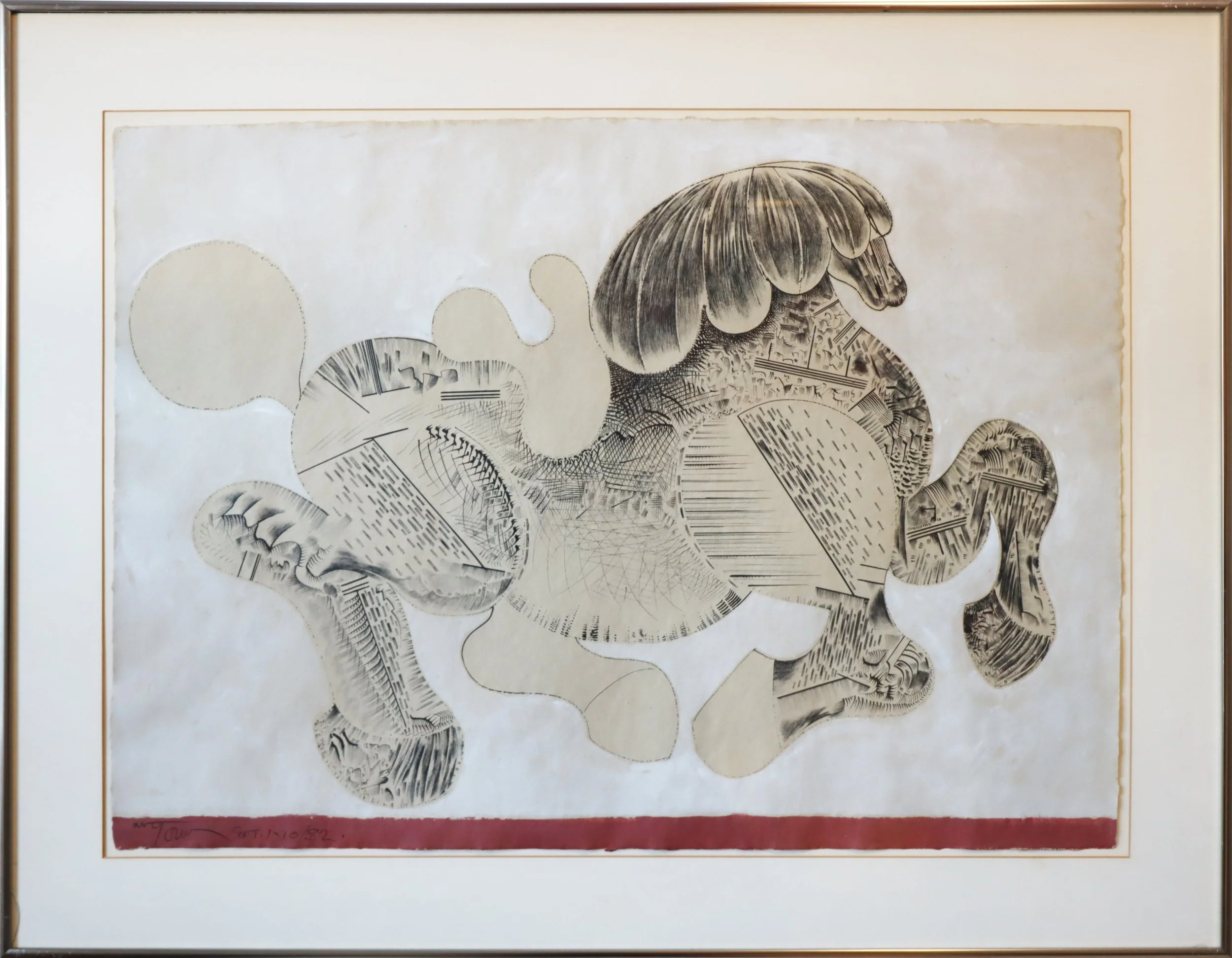
Harold Town. Toy Horse #265, 1982 mixed media 22 1/8" x 30 1/2" POR
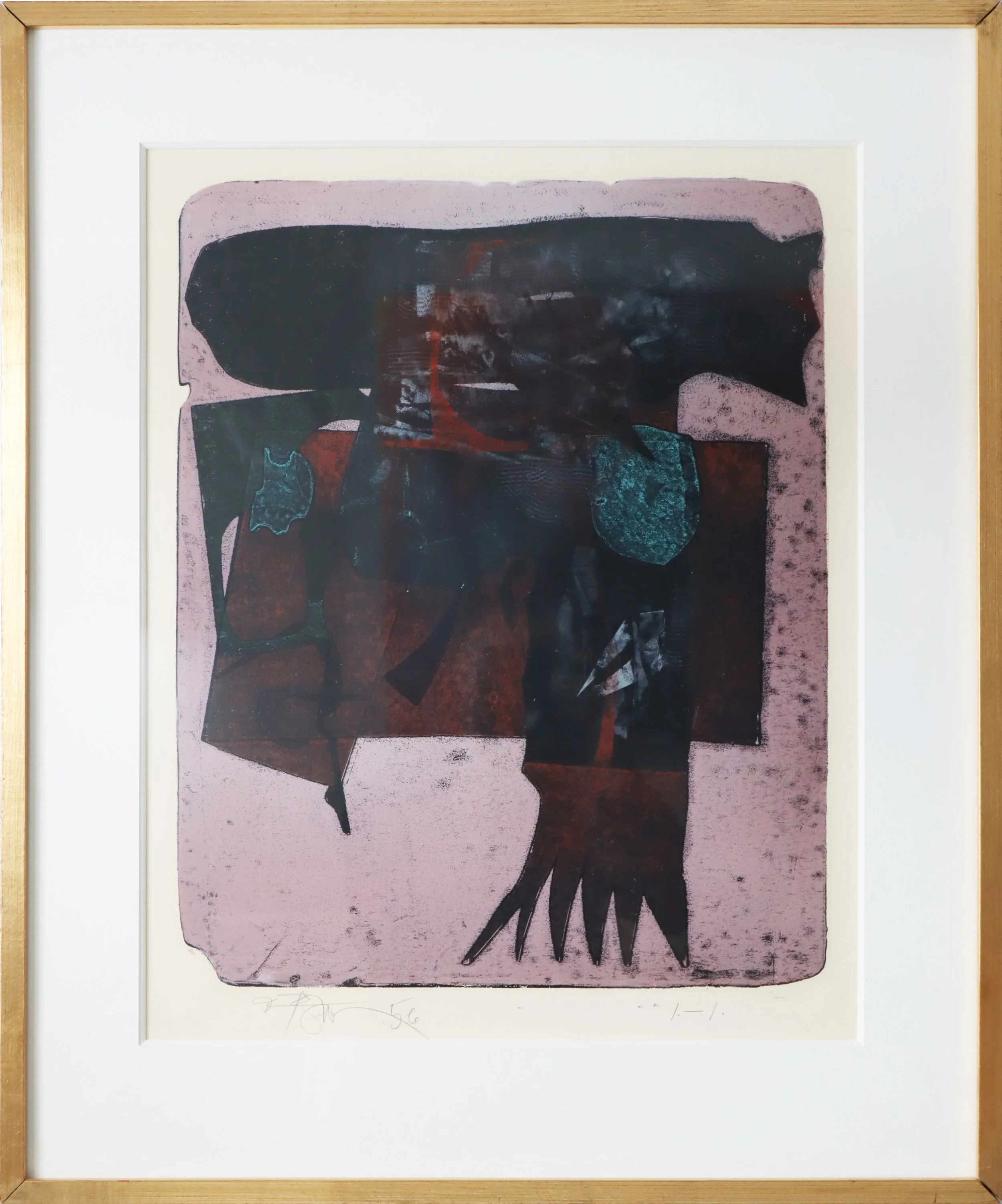
Harold Town. The Go West Sign, 1956 single autographic print 1 -1 19.75" x 15.75" POR

Artistic rendering referenced from a photograph by Peter Croydon 1957, copyright 2011 Lynda Shearer, all rights reserved
Harold Barling Town occupies a singular and historically significant position in Canadian art, and to own a work by Town is to hold a defining piece of the country’s postwar cultural transformation. As a founding member of Painters Eleven and one of the most visible artists in Toronto from the 1950s through the 1970s, Town was instrumental in legitimizing abstraction in English Canada and shifting the nation’s art conversation from landscape-based nationalism toward international modernism.
Town’s importance begins with Painters Eleven, the group that decisively broke with the conservative dominance of the Group of Seven legacy. When Painters Eleven debuted at Roberts Gallery in 1954, abstraction was still widely resisted in Toronto. Town, who coined the group’s name, emerged as its most forceful advocate and public voice. The group’s impact cannot be overstated: they forced Canadian institutions, critics, and collectors to engage with Abstract Expressionism and contemporary abstraction at a moment when such work was still controversial. For collectors, this positions Town not simply as an individual talent, but as a catalyst—an artist whose work marks a foundational shift in Canadian art history.
International recognition followed early and decisively. Town represented Canada at the Venice Biennale in 1956 and at the São Paulo Biennial in 1957 and again in 1961, an achievement that places him among a small group of Canadian artists of his generation to gain sustained international exposure so early in their careers. His innovative “single autographic prints”—complex, one-of-a-kind works created from collaged materials on printing plates—were exhibited in New York and Europe and are now regarded as some of the most inventive print works produced in Canada during the postwar period. These works, in particular, are highly prized by collectors for their uniqueness, technical daring, and historical importance.
Town was relentlessly prolific and deliberately resisted being confined to a single style. For collectors, this breadth offers multiple points of entry, from gestural abstract paintings of the 1950s that align with the high-water mark of Abstract Expressionism, to the intricate “Enigma” drawings of the early 1960s, to later collage-based and pop-inflected works that reflect the cultural turbulence of their time. His best works from the 1950s and 1960s are now widely regarded as canonical examples of Canadian postwar abstraction, combining painterly intensity with graphic sophistication rooted in his early training as a commercial illustrator.
Beyond the studio, Town’s impact extended into public and institutional life. He completed major murals for the St. Lawrence Seaway Power Project, the North York Public Library, Toronto’s Telegram Building, and Malton Airport, embedding modern abstraction into civic space at a national scale. He designed sets and costumes for the National Ballet of Canada and illustrated significant literary publications, reinforcing his role as a cultural figure whose influence reached far beyond the gallery wall. In recognition of his contributions, he was appointed an Officer of the Order of Canada in 1968 and received multiple honorary doctorates—honours that underscore his stature within Canadian cultural history.
Town’s career also carries the complexity that serious collectors often value. By the late 1960s and 1970s, shifts in critical fashion toward minimalism and conceptual art led to a cooling of institutional enthusiasm, even as Town continued to produce ambitious and challenging work. This arc—early acclaim, subsequent resistance, and later reassessment—has become increasingly familiar in the histories of major modern artists. Today, that reassessment is well underway. Scholarly work, notably Gerta Moray’s Harold Town: Life & Work, has reaffirmed his central role in shaping Canadian modernism, while museums and private collectors continue to refine and strengthen holdings of his most significant periods.
Collector’s Perspective:
For collectors, acquiring a Harold Town is not merely an aesthetic decision; it is an investment in a cornerstone of Canadian art history. His works anchor collections focused on postwar abstraction, Painters Eleven, and the internationalization of Canadian art. Held in the collections of the National Gallery of Canada, the Art Gallery of Ontario, and major private collections across the country, Town’s strongest works carry both historical gravitas and enduring visual power. To own a Harold Town is to own a work by an artist who helped redefine what Canadian art could be—and whose legacy continues to grow in clarity and importance with time.