
Art & Taxes in Canada: What Every Collector Should Know This Season

As tax season approaches, many collectors and clients start asking the same question:
“Can I actually claim art on my taxes?”
The short answer is—yes, in certain cases.
But like most things involving tax, the details matter.
More importantly, tax advantages should support a decision—not drive it. The real value of art still comes down to the artist’s market, demand, and long-term trajectory. That said, if you’re already considering acquiring work, there are some meaningful financial benefits worth understanding.
Buying Art for Your Business
If you purchase artwork for a business environment—an office, reception area, or any space where clients regularly visit—it may qualify as a business asset.
In most cases, the cost of the artwork isn’t deducted all at once. Instead, it’s depreciated over time through what’s called Capital Cost Allowance (CCA).
For original Canadian artwork:
It typically falls under a category that allows you to deduct a percentage of the value each year
This gradually reduces your taxable business income
If you’re registered for GST/HST, you may also be able to recover the tax paid on the purchase
From a practical standpoint, this means you can enhance your space with meaningful work while spreading out the financial benefit over several years.
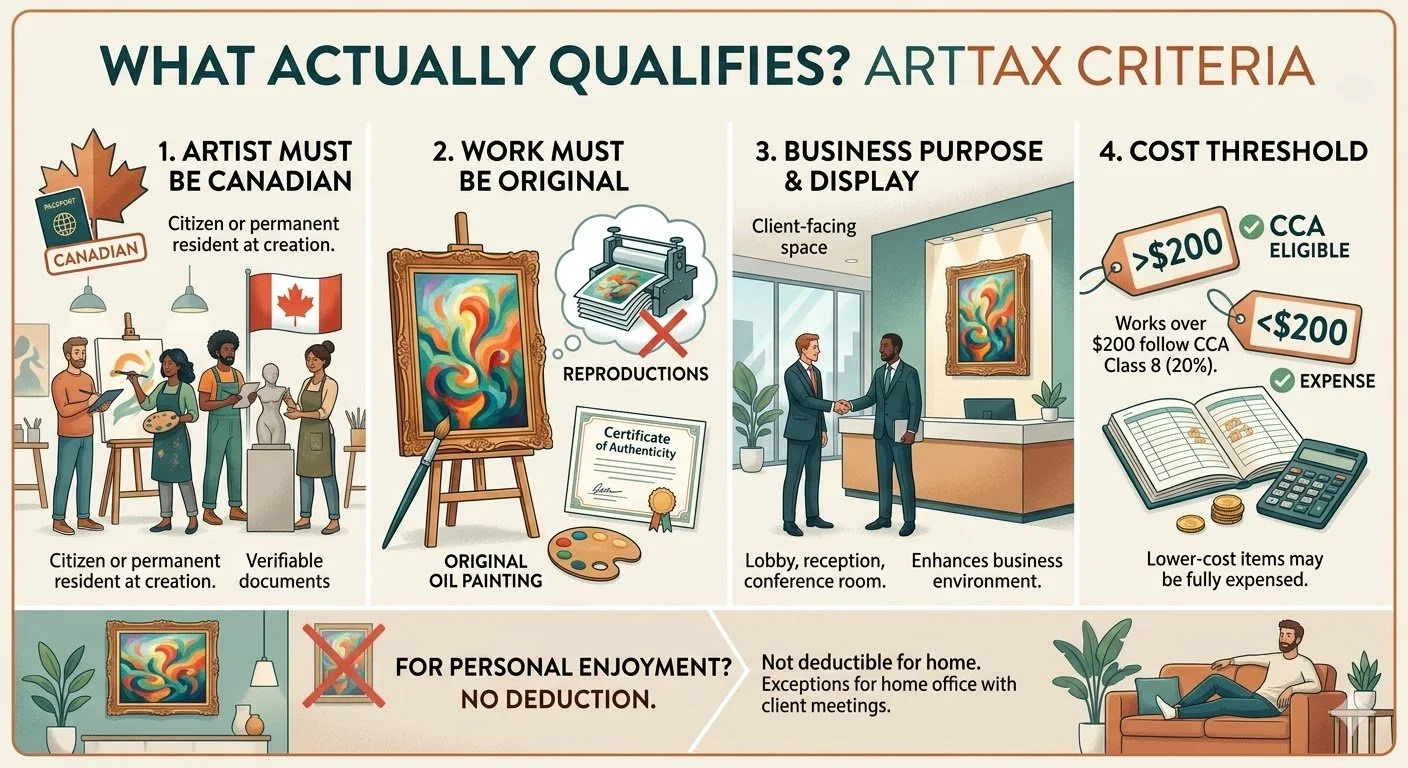
What Actually Qualifies?
This is where it becomes more specific—and where many assumptions fall apart.
To qualify for these kinds of deductions, the artwork generally needs to meet a few key criteria:
The artist must be Canadian (a citizen or permanent resident at the time the work was created)
The work must be original (not a reproduction)
The purpose must be tied to business activity—typically meaning it’s displayed in a client-facing space
The cost threshold matters—works over a certain value are treated differently than lower-cost pieces
If a work is purchased primarily for personal enjoyment—say, for your home—it won’t qualify in the same way. However, there can be some flexibility if you have a home office where you regularly meet clients.
Donating Art: A Different Level of Benefit
For more established collectors, donating artwork can offer even stronger tax advantages.
There are generally two paths:
1. Standard Donation
You receive a tax receipt based on the fair market value of the artwork
This can be used to offset a portion of your income
2. Certified Cultural Property
This is where things become significantly more advantageous.
If a work is deemed to be of national importance and donated to a designated institution:
You may not pay capital gains tax on the appreciation
You can potentially offset a much larger portion of your income
It’s a more complex process, but for major works, it can be a very strategic decision.

A Practical Reality Check
This is the part that often gets overlooked.
If you claim depreciation on a work over time and later sell it:
You may need to “recapture” those deductions as income
If the work has increased in value, you could also trigger a capital gain
In other words, the tax benefit isn’t a loophole—it’s a timing advantage.
From a Consultant’s Perspective
In our experience working with clients, the most successful collections are never built around tax strategy alone.
They’re built around:
Understanding an artist’s market
Recognizing where demand is growing
Balancing budget with long-term potential
Pricing, for example, is not based on the cost of materials—it’s driven by the artist’s career, their exhibition history, and the demand for their work. If an artist doesn’t yet have a strong market, their pricing remains at an early stage until that demand builds.
Tax advantages can absolutely support a purchase—but they shouldn’t justify one.

Art has a unique position—it lives at the intersection of culture, investment, and personal experience.
Tax advantages are part of that conversation, especially for businesses and established collectors. But the strongest acquisitions are still the ones that make sense beyond the numbers.
If you’re exploring options—whether it’s acquiring work for a space or building a collection over time—it’s always worth approaching it with both perspective and strategy.
