
PAUL SLOGGETT
(b. 1950, Campbellford, Ontario, Canada)

Paul Sloggett. Colour of Ideas, 2011 acrylic on canvas 78.5" x 65" $16,400

Paul Sloggett. Quarry, 2013 acrylic and oil on canvas 50" x 50" (losangique pyramidal) $11,500

Paul Sloggett. Spinaker Breeze, 2010-2020 acrylic and oil on canvas 65" x 50" $13,000

Paul Sloggett. Black & White Optic Bucktail, 1979 35" x 26" $7,000

Paul Sloggett. Arctic Range (Free Radical #5), 2020 acrylic and oil on canvas 48" x 32" $9,400

Paul Sloggett. Bergman Fontinalis, 1979 acrylic on canvas 37" x 23" $7,000

Paul Sloggett. Canadian Shield #8, 1979 acrylic on canvas 60" x 50" $10,000
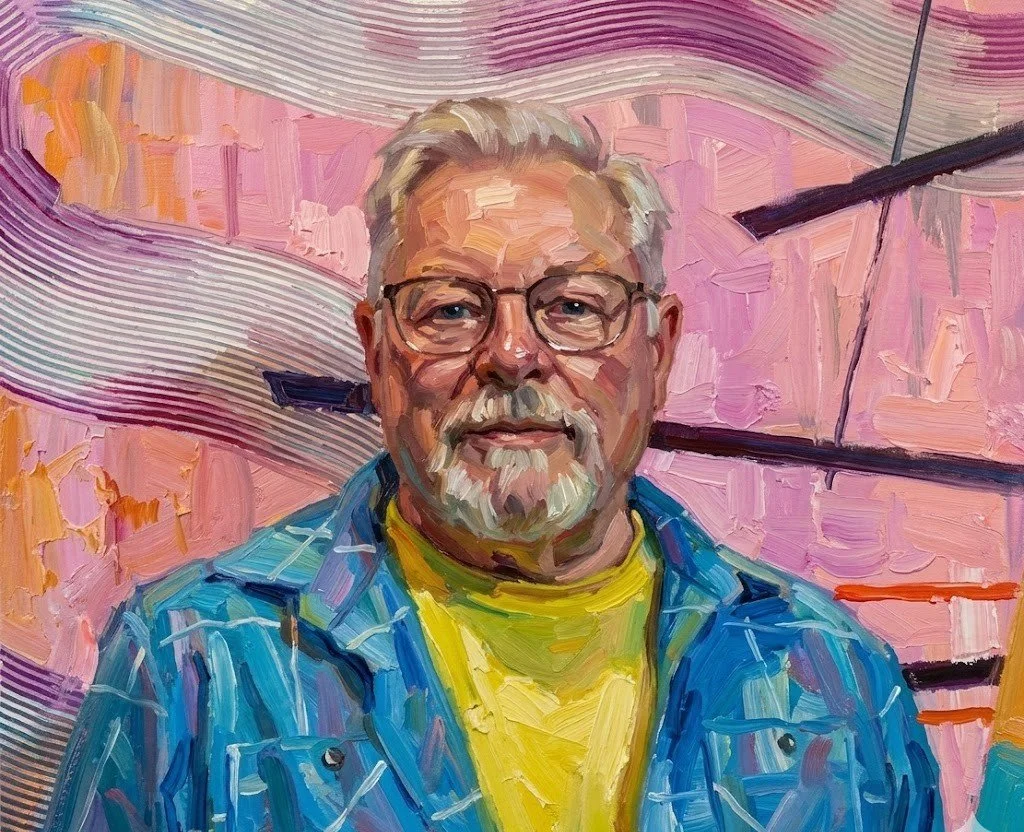
For collectors, Paul Sloggett represents an important and enduring contribution to Canadian abstraction. His work occupies a significant position within the country’s modernist lineage, bridging postwar geometric painting with a distinctly contemporary visual intelligence. As a senior Canadian abstract artist whose career spans more than five decades, Sloggett’s production is naturally finite, making major works from key periods especially meaningful acquisitions. Large, resolved canvases that express his crystalline geometric language and architectonic spatial construction are particularly sought after by collectors who value historically grounded, intellectually rigorous abstraction.
Born in 1950 in Campbellford, Ontario, and raised in Oshawa, Sloggett emerged as part of the so-called third generation of Canadian abstract painters. His development was shaped by early mentorship from high school teacher Murray Hofstetter and by exposure to the work of American modernist Richard Diebenkorn at the Robert McLaughlin Gallery. These formative experiences helped shape his lifelong exploration of colour, structure, and the expressive possibilities of the pictorial field.
Sloggett studied at the Ontario College of Art and Design University from 1969 to 1973, earning the AOCA designation. During this pivotal period in Toronto’s contemporary art scene, he studied under influential Canadian artists including Dennis Burton, Graham Coughtry, and Gordon Rayner, absorbing the intellectual energy of emerging postmodern abstraction. He later received a Teaching Assistantship under Royden Rabinowitch, then chair of Experimental Art, reinforcing his interest in conceptual structure and process-driven making.
Art historically, Sloggett is associated with a Canadian neo-constructivist direction within abstraction. His work reflects the influence of modernist painters such as Jack Bush, Frank Stella, and Kenneth Noland, as well as the broader legacy of Painters Eleven. Rather than adopting stylistic imitation, Sloggett transformed these influences into a highly personal visual vocabulary defined by architectonic geometry and spatial tension.
His paintings are often described as constructions rather than images. Sloggett has stated that he has always felt he was “building paintings rather than painting pictures.” This philosophy is evident in his shaped canvases, faceted geometric structures, and collage-like spatial layering, which create optical ambiguity between solidity and atmosphere. His work transforms abstraction into visual architecture, where colour planes interact rhythmically across the surface.
Colour functions as a primary expressive force in Sloggett’s practice. His palette reflects a near-synesthetic relationship to chromatic experience, where colour operates as emotional, temporal, and sensory metaphor. Influenced by musical rhythm and structure—Sloggett is also an accomplished drummer—his compositions often possess a syncopated cadence that animates geometric form with dynamic movement.
Early institutional recognition included major exhibitions at the Art Gallery of Ontario and the Hirshhorn Museum and Sculpture Garden, establishing his national and international profile. Over the decades, he has exhibited with prominent Canadian galleries including David Mirvish Gallery, Moore Gallery, John Mann Gallery, and Hatch Gallery.
Sloggett has also contributed significantly as an educator. He taught at the Ontario College of Art beginning in 1978, eventually becoming full professor in Drawing and Painting and serving as Assistant Dean of Faculty of Art. His academic influence extended to York University and continues today through teaching at Seneca Polytechnic.
His work is held in major public collections including the Canada Council Art Bank, the Art Gallery of Ontario, the Winnipeg Art Gallery, and the Beaverbrook Art Gallery, along with numerous private and corporate collections internationally. In 2001, he was elected to the Royal Canadian Academy of Arts.
Now based in Newcastle, Ontario, Sloggett continues an active studio practice. His career stands as a significant chapter in Canadian abstraction, offering collectors the opportunity to acquire works that combine historical importance, technical sophistication, and enduring visual vitality.
Collector’s Perspective:
From a collector’s perspective, works by Paul Sloggett offered here are drawn from the Mann Collection and have been exhibited at the John Mann Gallery. These paintings represent resolved examples of the artist’s mature geometric abstraction, combining structural clarity with vibrant chromatic presence. Sloggett’s senior career status and the naturally finite nature of his production add to the significance of acquiring works from this body of exhibition-provenance pieces.
Adding Sloggett’s work to a Canadian collection is an investment in one of the country’s important abstractionists whose career bridges modernist heritage and contemporary visual thought. His paintings carry historical relevance within Canadian art history while maintaining strong aesthetic and scholarly longevity, making them particularly meaningful for collectors building serious national modernist or postwar abstraction holdings.
For images and acquisition details, please contact us.
Isolated Conversations with Paul Sloggett
In 2020, the John Mann Gallery (formerly 13th Street Gallery) produced Isolated Conversations, an intimate video series featuring some of Canada’s most renowned artists and gallerists, created during a time when social distancing and staying home were vital to help flatten the curve and curb the spread of COVID-19.
Paul Sloggett inverview 1987
In this episode of "From the Moore Gallery", Abstract artist Paul Sloggett interviewed in 1987 with gallerist Ron Moore. Courtesy of Rogers TV. From the collection of the Art Gallery at PAMA.