
CAMPBELL SCOTT
(1930-2013 b. Milngavie, Scotland)
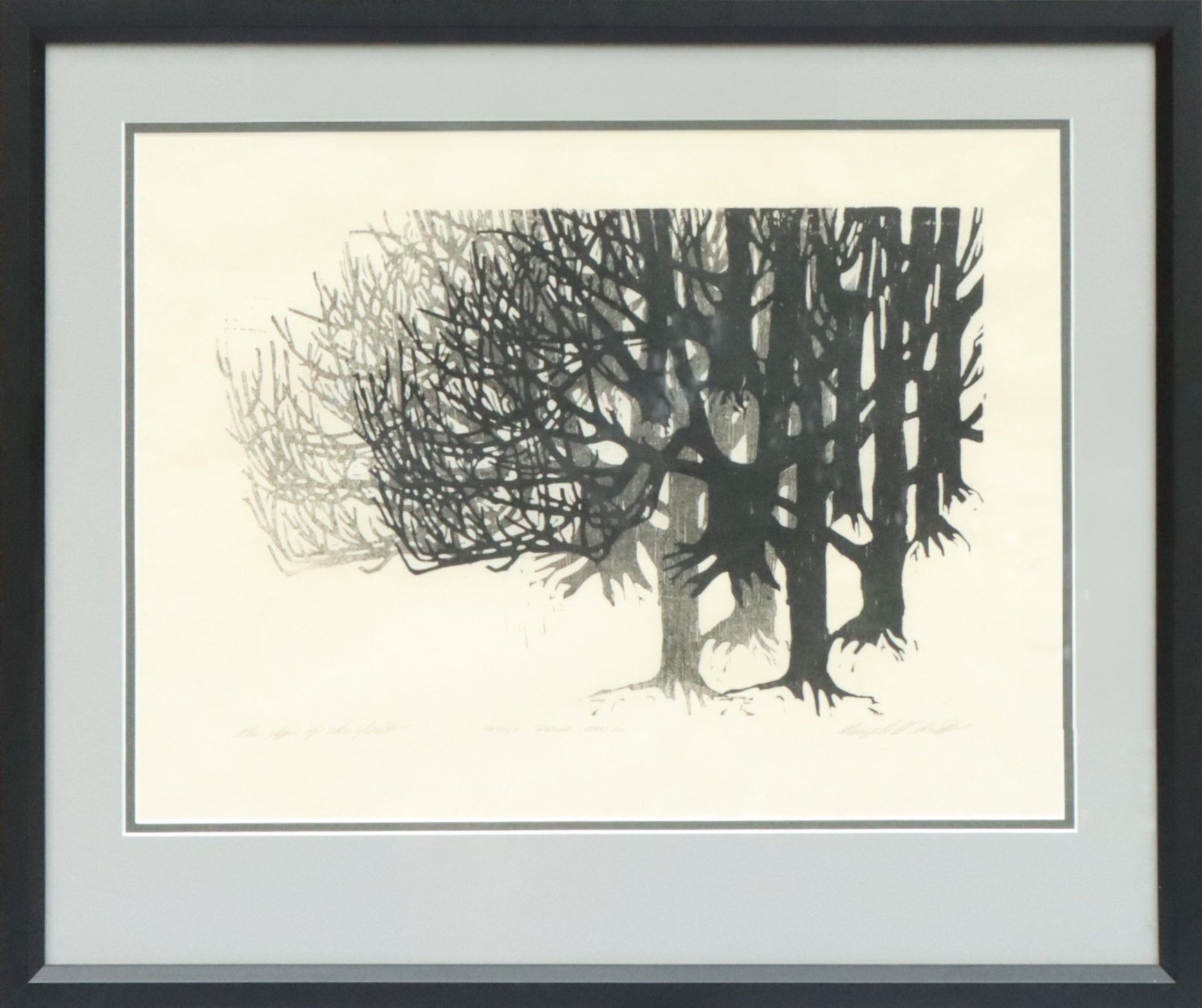
Campbell Scott. The Edge of The Forest, 1961 woodblock print (artist proof) 24" x 28"
Campbell Sydney Scott occupies a distinctive place within Canadian modernism as an artist who united European technical mastery with the evolving visual language of postwar abstraction in Canada. Scottish-born and later deeply embedded within Ontario’s Niagara Peninsula, Scott built a remarkable multidisciplinary practice spanning printmaking, painting, sculpture, woodcarving, and education—creating a body of work that remains compelling for collectors interested in regional modernism, master craftsmanship, and historically grounded abstraction.
Born in Milngavie, Scotland, Scott studied at the prestigious Glasgow School of Art, graduating with its Medal of Honour before completing a rigorous apprenticeship that earned him designation as a Master Woodcarver. This early immersion in structure, material intelligence, and disciplined making became foundational to his artistic language. He later expanded his training internationally, studying at the influential Atelier 17 in Paris under Stanley William Hayter and continuing advanced studies in Copenhagen, experiences that placed him in direct dialogue with some of the most important printmaking innovations of the twentieth century.
After immigrating to Canada in 1951, Scott settled in Niagara, where he established both an influential teaching career and a lasting artistic legacy. For over three decades as an educator in St. Catharines, he shaped generations of artists while maintaining an ambitious studio practice rooted in experimentation and precision.
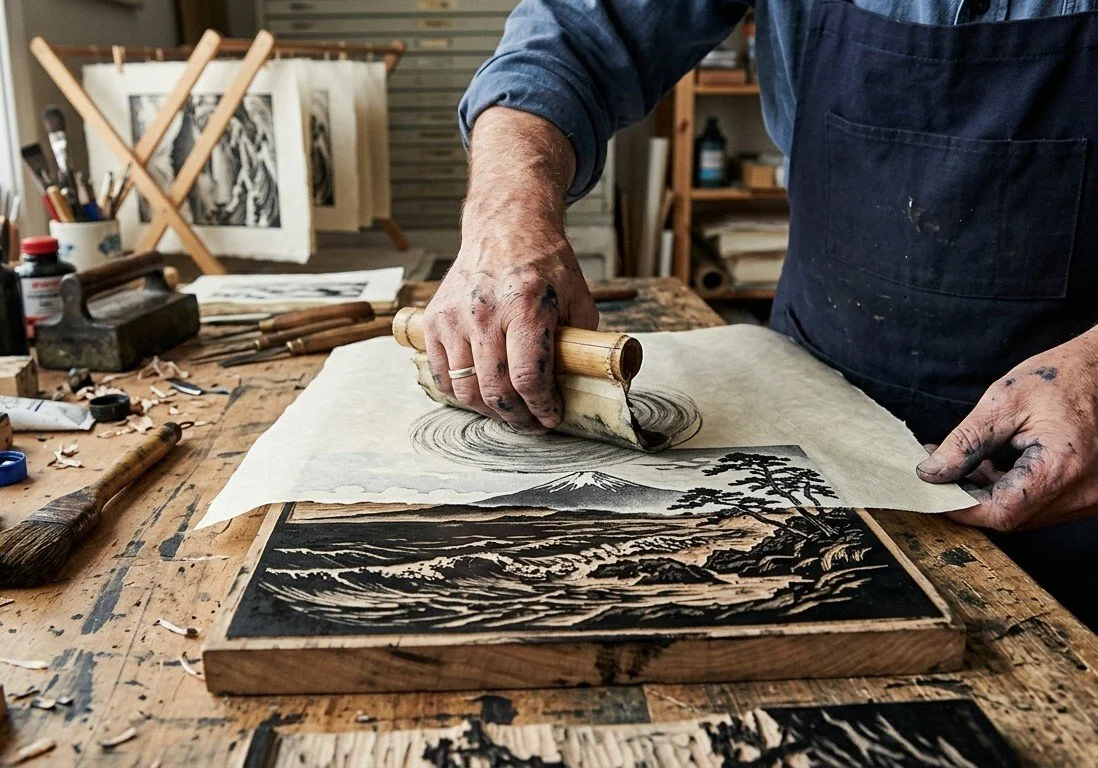
Collectors are particularly drawn to Scott’s printmaking and abstract painting for their synthesis of structure and intuition. His woodcuts, linocuts, and etchings reveal extraordinary technical sophistication, balancing geometric clarity with expressive depth. Architectural forms, layered planes, and stylized landscapes emerge through carefully controlled processes that reflect his deep understanding of carving and surface. In painting, Scott developed an additive approach—constructing compositions incrementally through accumulated pigment, deliberate mark-making, and spatial relationships rather than reduction or revision. The result is work that feels both disciplined and alive.
Scott’s practice extended beyond traditional media into a complete artistic worldview, perhaps best embodied in his self-designed modernist home and studio in Niagara-on-the-Lake, now recognized under the Ontario Heritage Act. Conceived and built over a decade, the residence reflects the same principles that define his artwork: craftsmanship, formal balance, and the integration of art into everyday life.
Today, Scott’s work is held in major public collections including the British Museum, Victoria and Albert Museum, Bibliothèque nationale de France, Scottish National Gallery of Modern Art, the Art Gallery of Ontario, and the Montreal Museum of Fine Arts, alongside important regional institutions in Niagara.
Collector’s Perspective:
Campbell Scott’s market presents an increasingly compelling opportunity for collectors seeking original examples of Canadian modernist printmaking and abstraction. While the artist’s legacy continues to remain visible through estate-managed reproductions and later editions, authentic early works produced during Scott’s lifetime—particularly original signed pieces—are becoming progressively more difficult to acquire.
As collectors continue to absorb material directly from the estate and secondary market circulation narrows, works carrying Scott’s original hand signature have emerged as the most desirable examples of his practice. These pieces offer a direct connection to the artist’s process and studio period, preserving the tactile qualities, decision-making, and craftsmanship that defined his approach to both printmaking and painting.