
WILLIAM RONALD
(1926–1998)
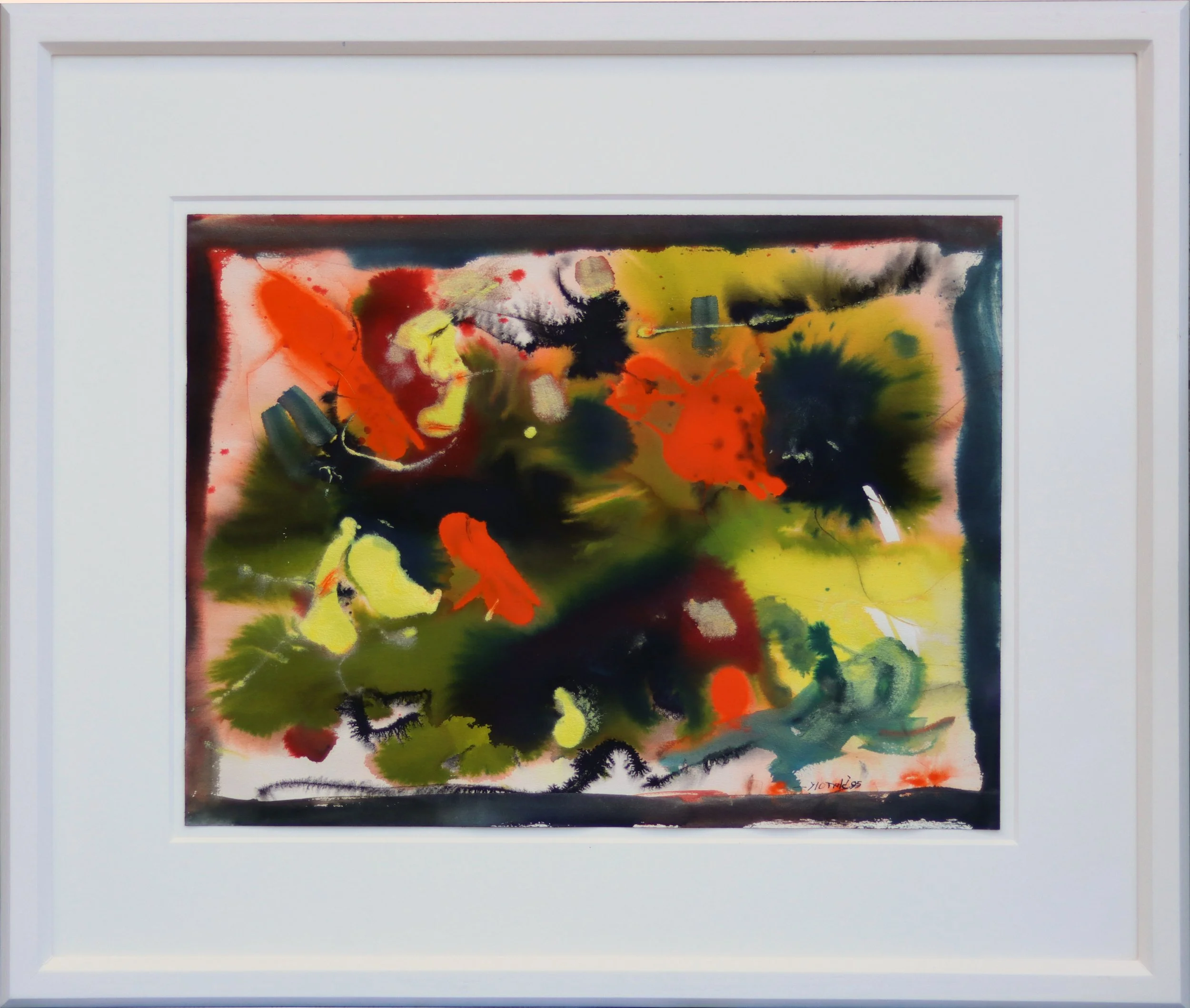
William Ronald. Untitled, 1998 watercolour 17.75" x 23.75" $3,000
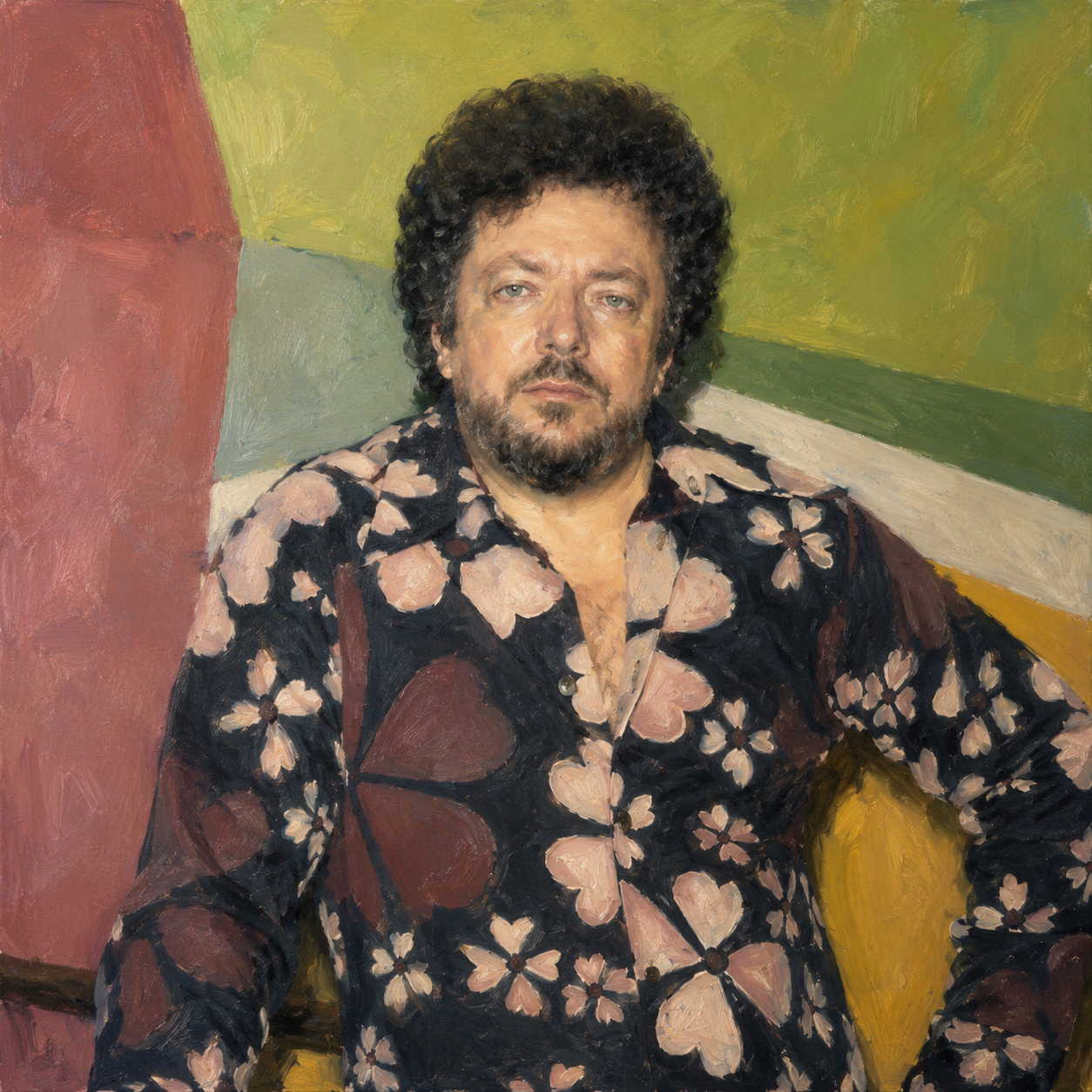
Artistic rendering of artist William Ronald. From the NAC Archives
Few artists altered the trajectory of Canadian art as decisively as William Ronald. As the founding catalyst behind Painters Eleven, Ronald helped dismantle the dominance of landscape tradition in postwar Canada and introduced abstraction as a serious and internationally relevant force within Canadian culture. His contribution was not simply stylistic—it was structural. Ronald created new possibilities for what Canadian art could be and, in doing so, established himself as one of the most important architects of modern Canadian art history.
For collectors, William Ronald occupies a particularly compelling position: he is both historically foundational and increasingly appreciated for the breadth of his career. While his early New York-period works remain among the most celebrated examples of Canadian Abstract Expressionism, serious collectors have increasingly recognized that Ronald’s later production deserves equal consideration—not as an epilogue to his career, but as a continuation and expansion of the same restless creative ambition.
Born William Ronald Smith in Stratford, Ontario, in 1926, Ronald demonstrated artistic determination from an early age, supporting his studies at the Ontario College of Art while working night shifts in an aircraft factory. Rejecting the conservatism of academic painting and seeking personal and artistic reinvention, he dropped the surname Smith and emerged simply as William Ronald—a transformation that mirrored his commitment to building a new visual language for Canadian art.
His breakthrough came in 1953 through the formation of Painters Eleven, a collective that challenged the prevailing expectations of Canadian painting. At a time when the Group of Seven still defined the national imagination, Ronald and his fellow artists advocated for abstraction as an essential contemporary movement. Their exhibitions introduced audiences to a more international, experimental vision and laid the foundation for Canada’s acceptance of modern painting.
Ronald’s ambition quickly extended beyond Canada. In 1955, he relocated to New York and entered the centre of the postwar art world. There he developed relationships with major figures of Abstract Expressionism and secured representation through the prestigious Kootz Gallery. Over seven solo exhibitions between 1957 and 1963, Ronald established himself as one of the few Canadian artists to achieve meaningful recognition within the fiercely competitive New York market.
This period produced the monumental paintings for which Ronald became best known. Unlike the all-over compositions of many of his contemporaries, Ronald developed his distinctive “central image” format—dense, heavily worked forms suspended within expansive pictorial space. These works combined emotional intensity with architectural control and remain among the defining achievements of Canadian abstraction.
For many years, collectors focused primarily on this celebrated New York period. Yet a more complete understanding of Ronald’s practice reveals that his later work deserves equal attention.
Following his return to Canada in the mid-1960s, Ronald entered a period of experimentation that broadened rather than diminished his artistic language. Throughout the 1970s and 1980s, he re-engaged abstraction with renewed freedom—applying paint directly from the tube, incorporating spray media, embracing luminous colour, and allowing gesture and spontaneity to dominate the surface. These paintings possess a confidence and immediacy that distinguish them from his earlier work while retaining the same physical intensity and command of scale.
Collectors increasingly recognize that these later works represent not decline, but evolution. They reveal an artist no longer concerned with establishing legitimacy and instead fully committed to the act of painting itself. The surfaces become more liberated, the colour more fearless, and the compositions more personal. In many cases, they offer a directness and energy that rivals—and sometimes surpasses—the restraint of the New York years.
His ambitious 1984 series The Prime Ministers, unveiled at the Art Gallery of Ontario, exemplifies this mature period. Translating political identity into abstract visual form, the series demonstrated Ronald’s ability to merge cultural commentary with painterly force and reaffirmed his position as one of Canada’s most ambitious public artists.
Today, William Ronald remains one of the strongest historical acquisitions within Canadian postwar art. His market appeal rests on a rare combination of qualities: institutional validation, foundational historical importance, international recognition, and a body of work that extends across multiple collecting categories and decades.
His paintings reside in major museum collections across Canada and internationally, ensuring continued scholarly attention and long-term relevance. Yet beyond institutional presence, Ronald offers something equally valuable to collectors: a career that rewards deeper engagement. Whether acquiring a pivotal New York-period canvas or a bold late abstraction, collectors are not purchasing a secondary chapter—they are entering into the full arc of one of Canada’s most influential artistic careers.
For serious collections focused on postwar Canadian art, William Ronald remains not only a historically important acquisition, but one whose later work continues to present meaningful opportunities for discovery, scholarship, and long-term appreciation.
Collector’s Perspective:
Today, William Ronald remains one of the most compelling acquisitions within postwar Canadian art. His enduring appeal lies in a rare convergence of qualities: foundational historical importance, international recognition, institutional validation, and a body of work that demonstrates remarkable consistency across decades. For established collectors, Ronald represents an opportunity to strengthen a collection with an artist who helped redefine Canadian art history. Equally, for those looking to introduce historically significant names into their collection, Ronald offers an accessible entry into museum-calibre Canadian abstraction. Whether acquiring a celebrated New York-period canvas or a bold late-career work, collectors are engaging with an artist whose legacy extends beyond a single movement or moment—one whose work continues to reward scholarship, hold cultural relevance, and occupy an essential place in the story of Canadian art.