
LESLIE ALAN REYNOLD
(b. 1947, Edmonton)
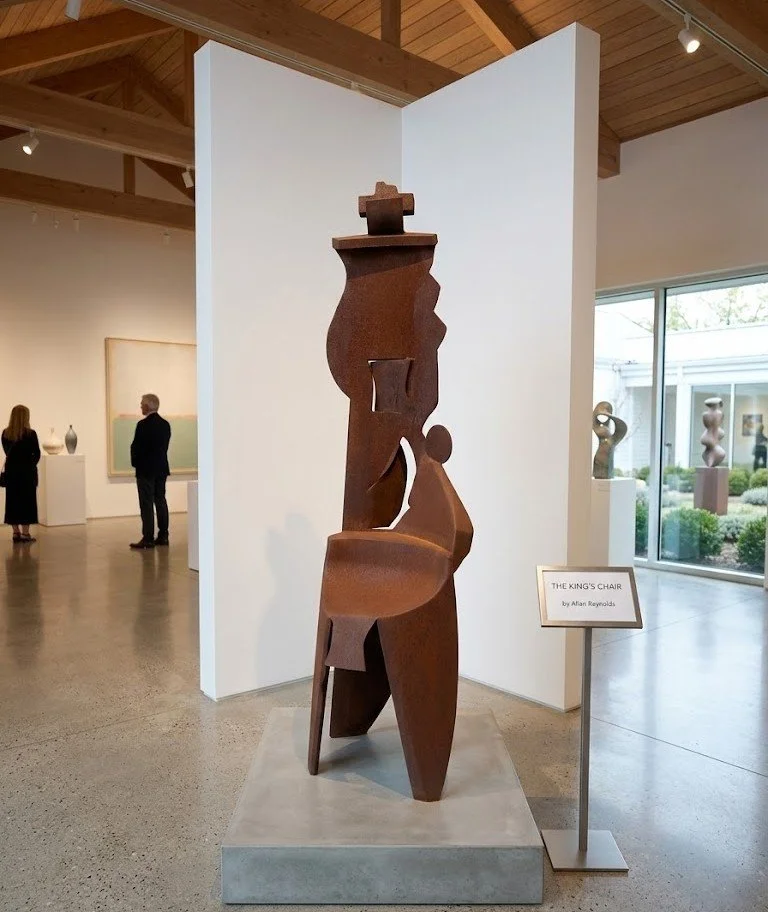
Leslie Alan Reynolds. The King's Chair, circa 1980 welded weathered steel 96"h x 65"w x 34" d $10,000
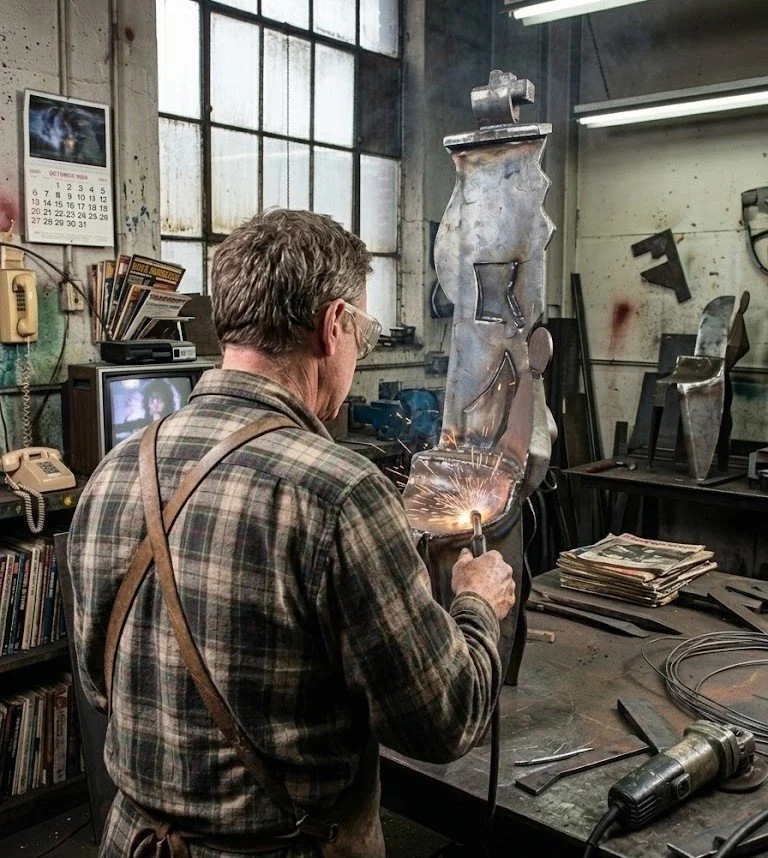
Born in Edmonton in 1947, Leslie Alan Reynolds is a significant figure in Canadian contemporary sculpture whose career has helped define the city’s modernist sculptural identity. Emerging from the constructivist tradition, Reynolds developed a disciplined formal language rooted in geometric abstraction, structural construction, and material intelligence. His work reflects the legacy of mid-20th-century modernism while maintaining a distinctly personal and regionally informed visual vocabulary.
Reynolds began his artistic practice in the early 1970s, initially working in laminated wood sculptures encouraged by American sculptor Michael Steiner. His early works explored monumental block structures resembling architectural walls and planar assemblages that emphasized mass, balance, and spatial tension. By the late 1970s, his compositions evolved into more complex table-like configurations of interlocking flat sheets, demonstrating his growing interest in sculpture as a constructed environment rather than a carved object.
The transition to welded steel in the early 1980s marked a pivotal moment in Reynolds’ career. Drawing on his familiarity with fabrication techniques, he quickly mastered the expressive and structural possibilities of metal. His mature works are characterized by cylinder and tub-inspired forms with fused lips, rims, and softened edges that merge industrial construction with tactile, almost ceramic sensibilities. These pieces often occupy a conceptual space between functional vessel, abstract body fragment, and autonomous sculptural presence.
Over time, Reynolds’ practice became increasingly referential without abandoning abstraction. His later body-oriented sculptures, including flattened anthropomorphic nudes such as Shadow Venus (2005) and Proud Mary (2006), explore duality and dimensional ambiguity, presenting front and back perspectives that suggest a third, implied spatial volume. His “horse pieces” similarly compress figuration into symbolic form, using vivid patinated surfaces to evoke saddle and blanket imagery while allowing the animal motif to remain visually subordinate to colour and surface articulation.
In his more recent studio phase, Reynolds has responded directly to the rural Alberta landscape surrounding his home and studio outside Edmonton. His steel “plant sculptures” demonstrate a refined sensitivity to natural light and seasonal variation through the use of zinc and copper patinas that shift with environmental conditions. This work reflects a broader intellectual dialogue with historical sculptural traditions, drawing inspiration from classical Greek sculpture, African and Polynesian sculptural forms, and the monumental aesthetics of China’s Tang Dynasty, cultures where sculpture functioned as both spiritual and formal expression.
Reynolds’ artistic philosophy is grounded in the modernist lineage shaped by figures such as Barnett Newman, Jules Olitski, and Clement Greenberg, emphasizing formal clarity, material truth, and the autonomy of sculptural structure. Yet his work also resists strict doctrinal minimalism through its subtle allusions to the human body, organic growth, and utilitarian object forms. This balance between intellectual abstraction and latent figuration has become a defining signature of his career.
Beyond his studio production, Reynolds has played a formative role in Edmonton’s artistic community as a mentor and cultural influence. His impact is particularly evident among younger sculptors who have benefited from his technical guidance and conceptual openness. The importance of his contribution was formally recognized in 1990 with the survey exhibition Inner Motifs: Fifteen Years of Exploration, organized by the Edmonton Art Gallery, which positioned his work within the broader development of Western Canadian modernism.
Reynolds’ representation over many years by the Douglas Udell Gallery and his continued exhibition activity through its successor gallery have helped sustain visibility for his work in both regional and national markets. Institutional collections holding his sculptures include the Art Gallery of Ontario, the Canada Council Art Bank, and the Winspear Centre, as well as government and civic collections such as the Alberta Government House Foundation.
From a market perspective, Reynolds’ sculpture has demonstrated steady collector interest, particularly for well-resolved steel works from his mature period. Auction records indicate a consistent sell-through rate with realized prices typically ranging from the mid-thousands, occasionally reaching higher levels for larger or exhibition-quality pieces. His work circulates primarily through private and regional institutional collections, reflecting a market anchored in connoisseurship rather than speculative trading.
Today, Reynolds continues to work and exhibit while maintaining a studio practice shaped by observation, material exploration, and historical reflection. At an advanced stage of his career, his production is measured and deliberate, reinforcing the rarity and cultural value of significant works from his long and influential practice within Canadian sculpture.
Collector’s Perspective:
For collectors of Canadian sculpture, Leslie Alan Reynolds offers a compelling combination of historical significance, material mastery, and long-term market stability. His work reflects a mature constructivist vision shaped through more than five decades of artistic development, moving from early laminated wood structures to the distinctive welded steel forms that define his most recognized period. Collectors are drawn to the physical presence and intellectual restraint of his sculpture, which bridges abstraction and subtle figuration while maintaining strong ties to Canadian modernist traditions. Institutional validation and consistent gallery representation further reinforce the credibility of owning his work.
From a collector’s perspective, Reynolds’ sculptures are particularly attractive because they balance aesthetic strength with dependable market performance. His mature steel works, especially body-inspired forms and patinated landscape-responsive pieces, circulate steadily in the secondary market with stable pricing and reliable sell-through rates. For collectors seeking Canadian sculpture with cultural resonance, historical grounding, and enduring visual impact, Reynolds represents a thoughtful acquisition that supports both connoisseurship and long-term collection quality.
For images and acquisition details, please contact us.