

Douglas Bentham with his sculptures, 2017
For centuries, Western sculpture was defined by mass, weight, and the removal of material. Whether a Renaissance master chipping away at a block of Carrara marble or a 19th-century realist modeling clay for a bronze cast, traditional sculpture occupied space as a solid, impenetrable volume.
In the 20th century, a radical shift occurred: artists stopped carving into mass and began building out into space. Few Canadian artists mastered this modernist syntax as fluently or as powerfully as Douglas Bentham (1947–2026).
From Revolutionary Russia to the Canadian Prairies
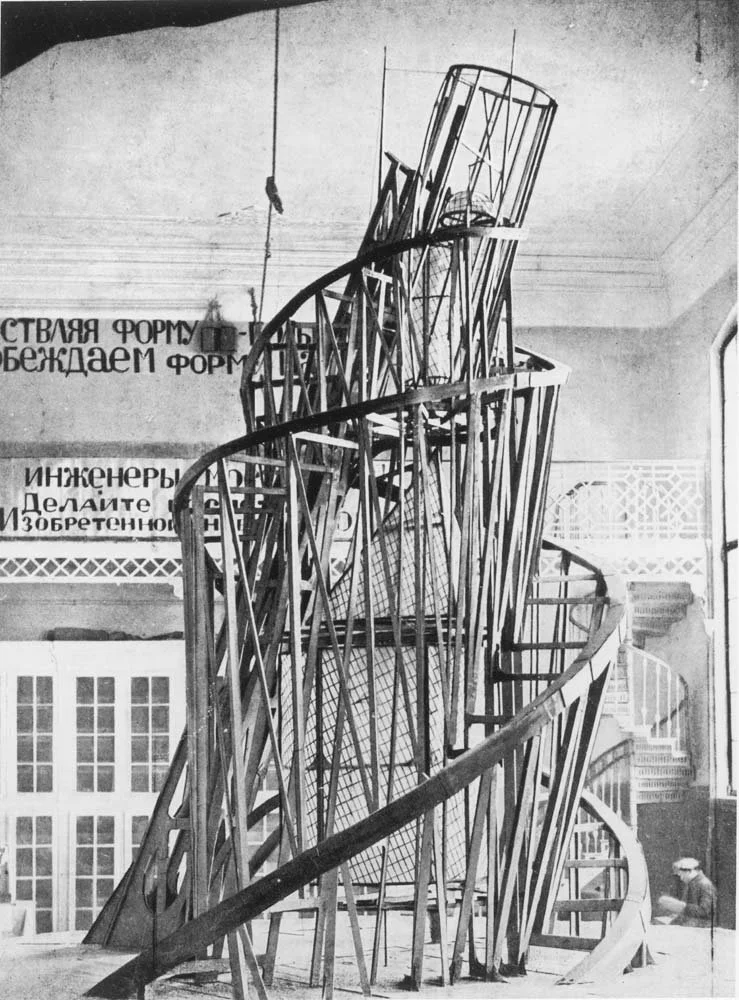
Model for the Monument to the Third International (1919–1920).
Source: MoMA
To understand Bentham’s sculptural language, we have to look back to Constructivism, the avant-garde movement born in Moscow around 1915–1921. Pioneered by figures such as Vladimir Tatlin and Naum Gabo, Constructivism rejected decorative "art for art's sake" in favor of industrial materials—iron, steel, glass, and wood—assembled using modern engineering methods.
As the movement migrated west through Europe and North America in the mid-20th century, its revolutionary political slogans fell away, leaving behind a revolutionary formal methodology. Through modernists like Julio González, David Smith, and British sculptor Sir Anthony Caro, Constructivism evolved into a pure investigation of structure, gravity, balance, and visual rhythm.
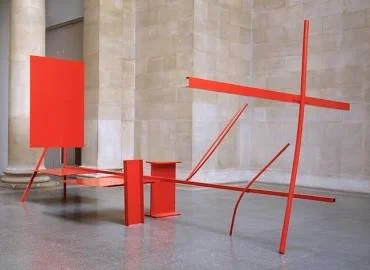
Sir Anthony Caro. Early One Morning (1962). Source: Tate
Bentham encountered this lineage firsthand at the legendary Emma Lake Artists’ Workshops in northern Saskatchewan—first as a young painter-turned-sculptor in 1969, and later co-leading the 1977 workshop alongside Anthony Caro himself. Under the vast, uninterrupted skies of the Canadian Prairies, Bentham translated international constructivist theory into a distinctly Canadian monumental idiom.
Three Pillars of Bentham’s Constructivist Practice
1. Additive Fabrication Over Subtraction
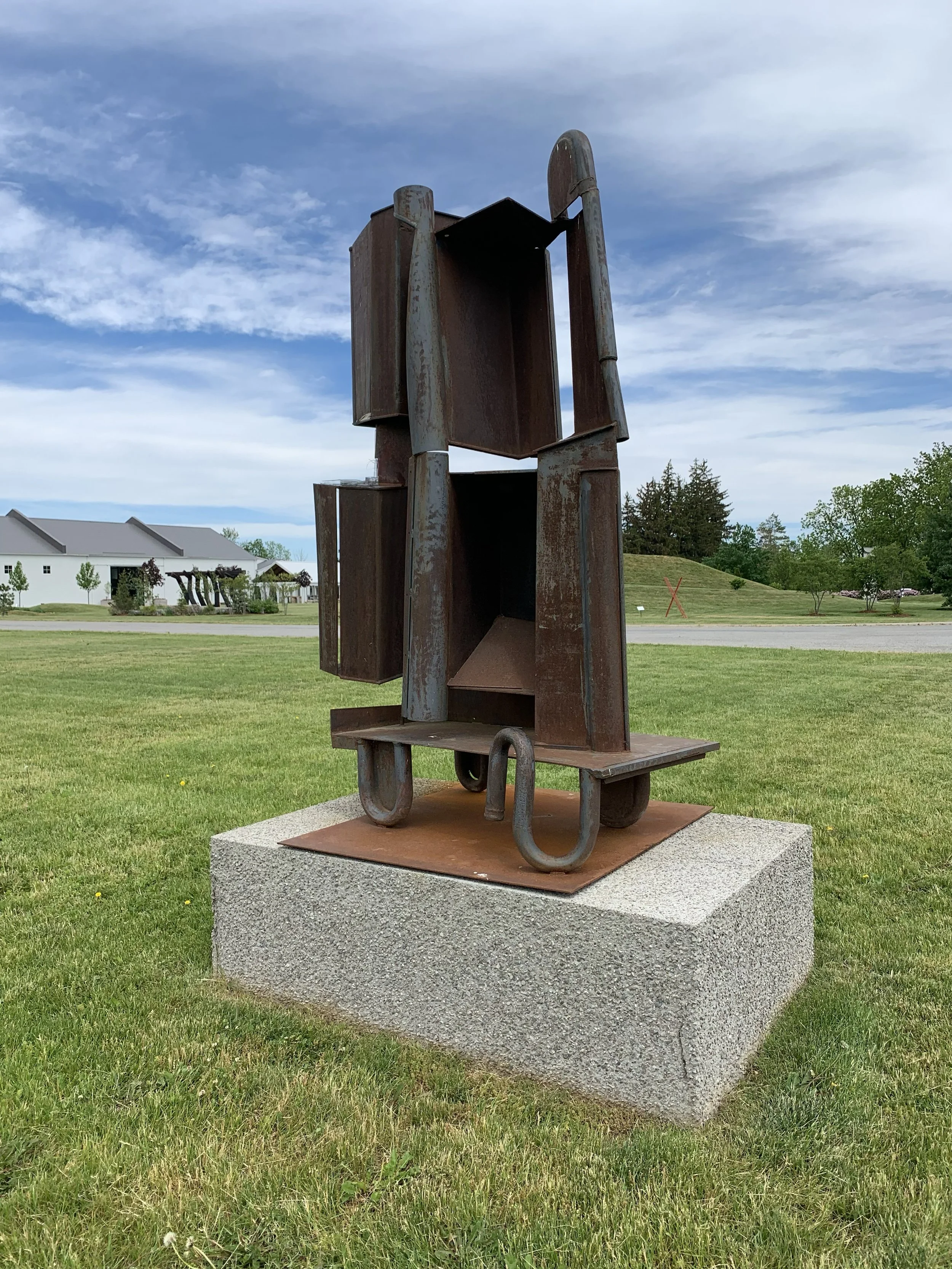
Douglas Bentham. Eternal Return, 1991 weathered steel 96" x 65" x 34"
Bentham approached his Dundurn, Saskatchewan studio less like a traditional atelier and more like an industrial fabrication workshop. Rather than carving away at a monolith, he practiced additive fabrication: selecting pre-rolled steel plates, I-beams, tubes, and curved remnants, and joining them together through welding, bolting, and structural tension.
Every weld seam, cut edge, and structural joint remains visible. In true constructivist spirit, Bentham never disguised his materials; he allowed the inherent strength and industrial honesty of Corten steel, brushed stainless steel, and brass to carry the visual authority of the work.
2. "Drawing in Space"
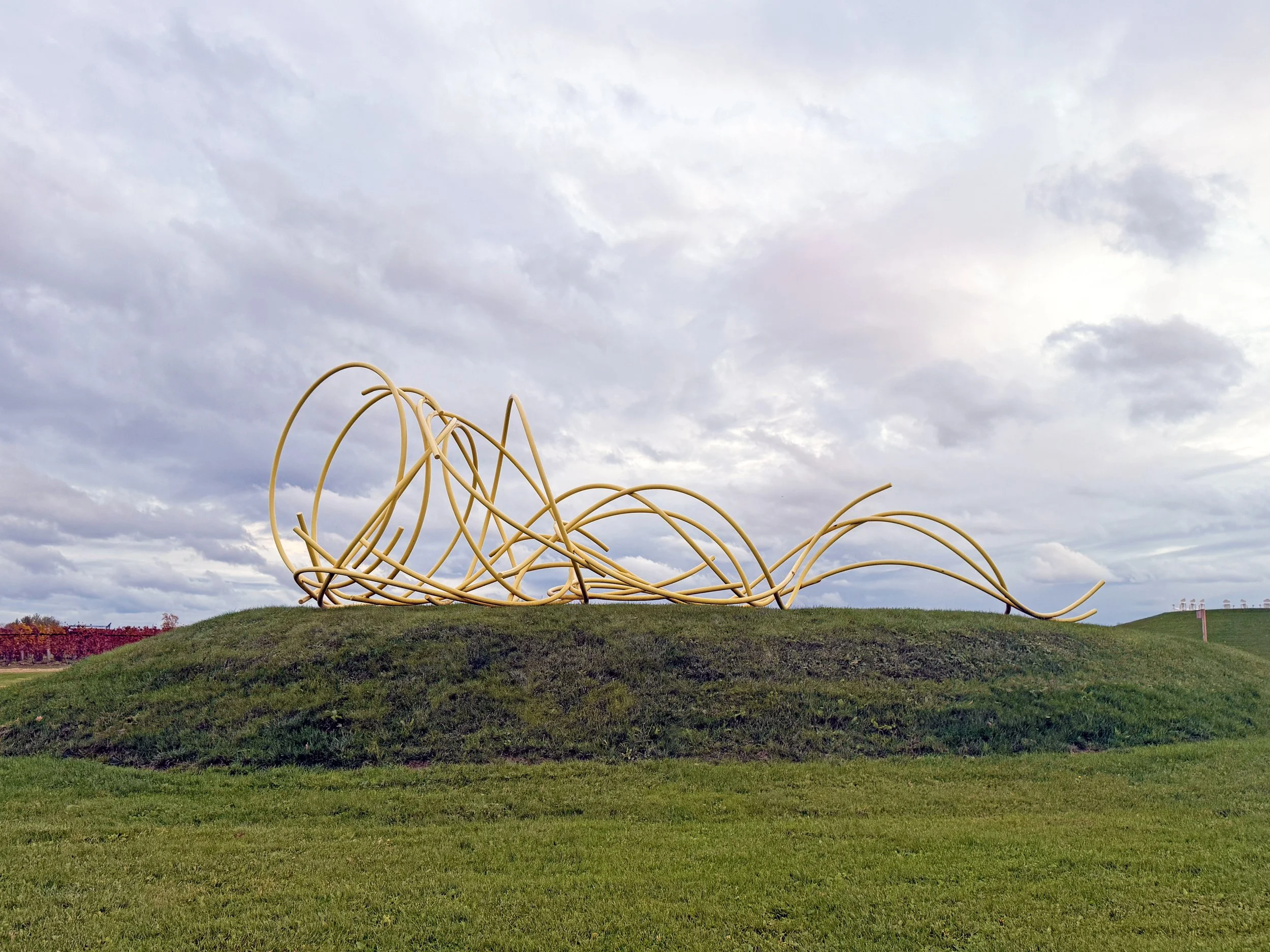
Douglas Bentham. Lemon Scribble, 2024 painted steel 25' x 78" x 105"
Critics and curators often describe modernist welded sculpture as "drawing in space", a phrase that captures the essence of Bentham’s visual syntax. Trained initially as a painter, Bentham never abandoned the expressive power of line and gesture; instead, he traded charcoal and canvas for steel rods and torch-cut plates.
When you walk around a Bentham sculpture, the work refuses to stay still:
Changing Profiles: From one angle, heavy steel planes align into a dense architectural silhouette; ten steps to the left, the sculpture opens up into sweeping calligraphic arcs and weightless linear rhythms.
Framing the Environment: Rather than blocking the landscape, Bentham’s sculptures act as viewfinders—framing segments of sky, foliage, and architecture within their open apertures.
3. Negative Space as a Sculptural Medium
In traditional figurative sculpture, air is simply what surrounds the statue. In Bentham’s constructivist works, negative space is an active, load-bearing element of the composition.
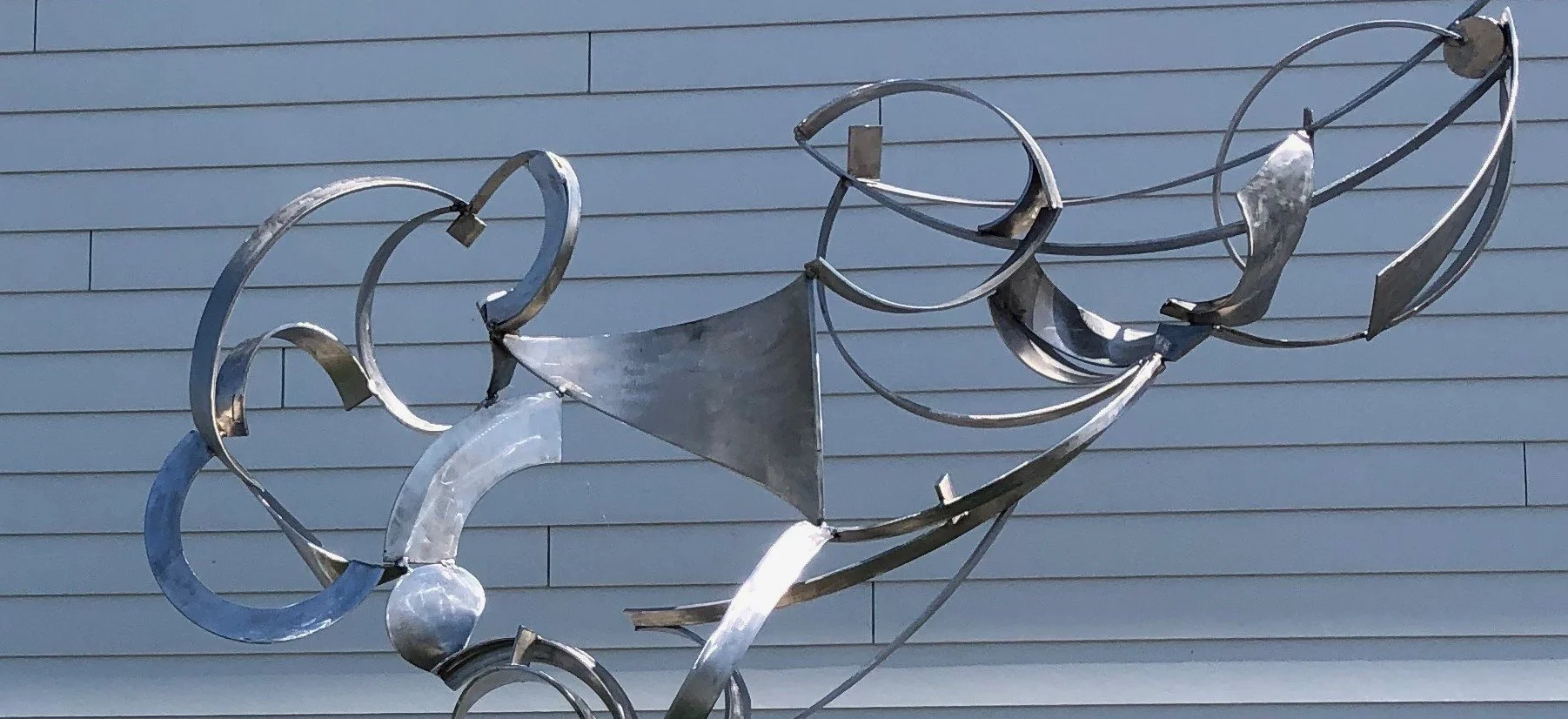
close up of Leonardo's Wind I, 2017 burnished stainless steel 81" x 87" x 27"
By cantilevering heavy geometric planes at daring angles and suspending curved steel ribbons across open voids, Bentham created a palpable tension between mass and emptiness. The pockets of air trapped between intersecting planes feel just as deliberate—and just as sculptural—as the steel itself.
Eliminating the Pedestal
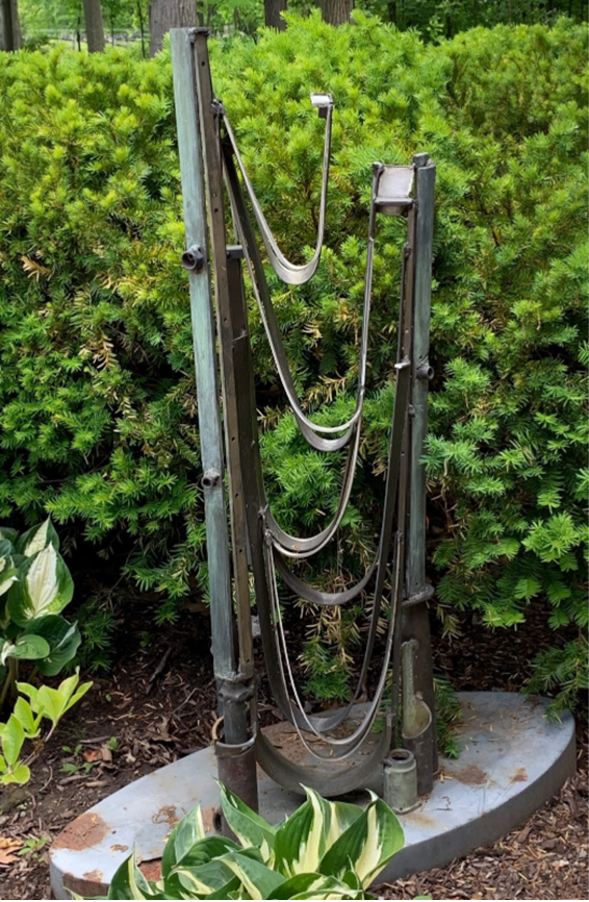
Douglas Bentham. Untitled. n.d. Stainless steel 46" x 14" x 11"
A defining hallmark of Bentham’s alignment with post-war modernist sculpture is his treatment of the ground plane. Following the precedent set by Anthony Caro, Bentham frequently eliminated the traditional stone or concrete plinth, placing his sculptures directly onto the earth, grass, or gallery floor.
Without a pedestal separating the artwork from the viewer's physical realm, a Bentham sculpture shares your space. You do not merely look up at it as a distant monument; you experience its scale, balance, and spatial choreography with your own body as you move around it.
