
DOUGLAS BENTHAM
(b. Rosetown, Saskatchewan RCA 1947 - 2026)

Douglas Bentham. Eternal Return, 1991 weathered steel 96" x 65" x 34" price on request (currently at 13th Street Winery)

Douglas Bentham. Lemon Scribble, 2024 painted steel 25' x 78" x 105" price on request (currently at 13th Street Winery)

Douglas Bentham. Gate II, Palmyra, 2015 burnished stainless steel 138" x 50" x 30" price on requst (currently at 13th Street Winery)

Douglas Bentham. Gate III, Pompeii, 2015 burnished stainless steel 123" x 50" x 34" price on request (currently at 13th Street Winery)
Douglas Bentham. Sentinel, 2001 weathered steel 15' x 7' x 5' price on request (currently at 13th Street Winery)

Douglas Bentham. Leonardo's Wind I, 2017 burnished stainless steel 81" x 87" x 27" price on request (currently at 13th Street Winery)

Douglas Bentham. Espalier Athena, 2007 stainless steel 160" x 36" x 38" price on request (currently at 13th Street Winery)

Douglas Bentham. The Tablets, consisting of 27 pedestal-scaled sculptures displayed on identical plinths, 2016 bronze, brass, steel various sizes price on request
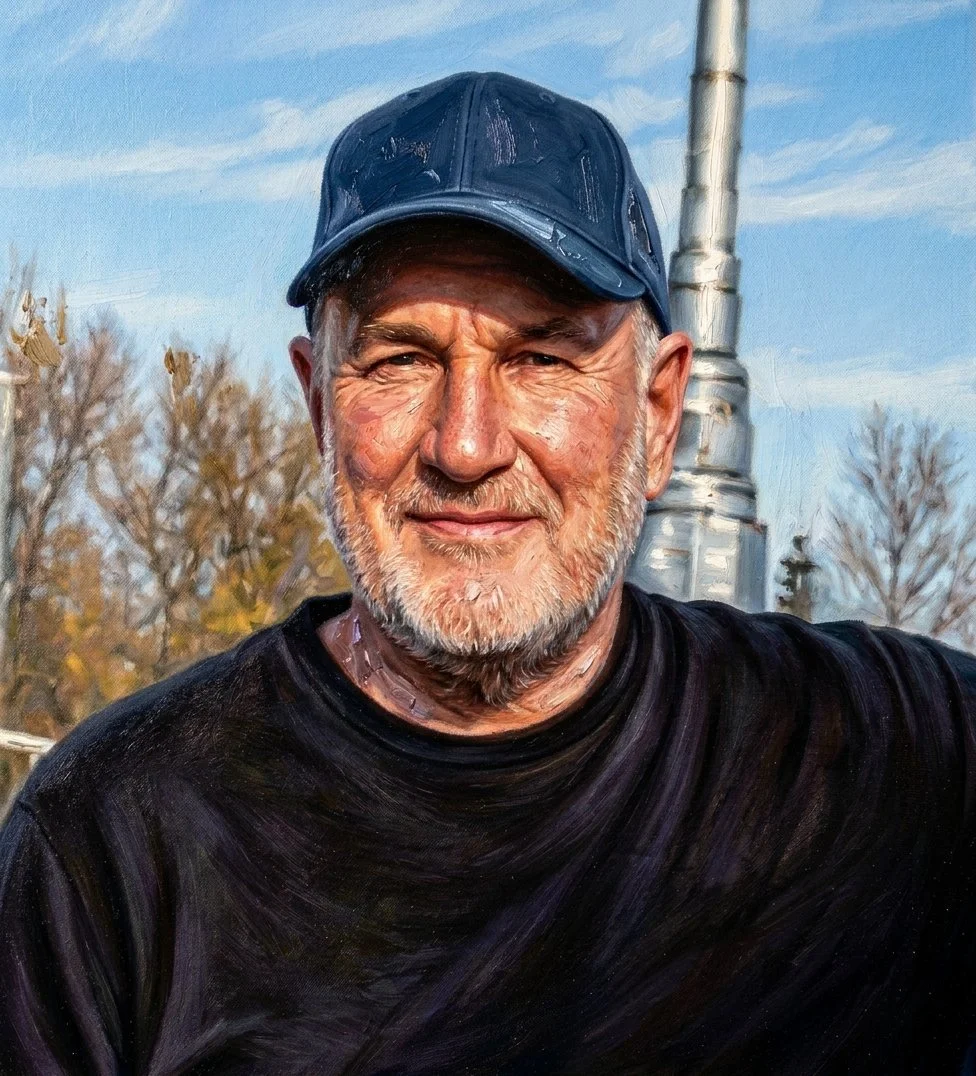
"He is one of the country’s most prolific sculptors, one of its finest, one of Canada’s first sculptors in every sense."
Terry Fenton, Art Critic and Former Museum Director
Douglas Wayne Bentham was a defining figure in Canadian abstract sculpture whose nearly six-decade career established him as one of the country’s most accomplished sculptors. His work occupies a significant place within the history of Canadian modernism, distinguished by its architectural sensibility, rigorous craftsmanship, and exploration of space, structure, and material. Born in Rosetown, Saskatchewan, and raised in Saskatoon, Bentham graduated from the University of Saskatchewan in 1969 with a BA Advanced degree in painting. A formative encounter with American sculptor Michael Steiner at the Emma Lake Artists’ Workshop that same year, together with his father’s mechanical background, encouraged his transition toward metal sculpture. He later completed an MFA in sculpture at the University of Saskatchewan in 1989, studying alongside influential Canadian artists Eli Bornstein and Otto Rogers.
Bentham developed a distinctive sculptural language through the manipulation of welded steel, stainless steel, bronze, brass, and wood. His compositions balance mass and openness, allowing light, shadow, and negative space to become integral to the work. Moving effortlessly between intimate tabletop sculptures and monumental public commissions, Bentham demonstrated an exceptional ability to translate abstract ideas into compelling physical forms. His public works, including Unfurled in Saskatoon and Skater’s Arch at Edmonton’s Rogers Place, reflect the ambition and formal intelligence that defined his practice. His smaller sculptures and assemblages offer collectors a more intimate encounter with the same architectural principles, material sensitivity, and precision. Elected to the Royal Canadian Academy of Arts in 1976, Bentham received the Canada Council’s Victor Martyn Lynch-Staunton Award in 1980. His participation in influential international workshops, including Emma Lake, Triangle, and Hardingham, further established his position within a broader dialogue of contemporary sculpture.
Bentham was an important participant in the international workshop movement, contributing to a network of artists whose exchanges helped shape contemporary sculpture. His involvement in the Emma Lake Artists’ Workshops, including co-leading the 1977 session with Sir Anthony Caro, placed him in direct dialogue with leading international sculptors. His participation in the Triangle Artists’ Workshop in New York and the Hardingham Sculpture Workshop in the United Kingdom further strengthened these connections. These experiences informed a practice that remained distinctly Canadian while engaging with the broader evolution of international abstraction. Bentham’s work reflects the influence of constructivist principles while establishing a distinctly Prairie sensibility, informed by the expansive geography and architectural character of Western Canada. Rather than relying on solid, enclosed forms, he explored the relationship between structure and space. His sculptures invite the viewer to consider not only the physical materials, but also the voids, intervals, and shifting perspectives that define the composition. This approach gives his work an enduring visual complexity, rewarding sustained engagement and making it particularly compelling within a considered collection.
His public commissions have become enduring elements of the Canadian urban landscape. Installed in cities including Saskatoon, Calgary, Edmonton, and Ottawa, these works demonstrate his ability to engage with architecture, public space, and the surrounding environment. His public sculpture establishes an important dimension of his legacy, while his studio works offer collectors the opportunity to experience the same artistic principles on a more intimate scale. Beyond his artistic achievements, Bentham was a committed advocate for the Canadian arts community, co-founding the Saskatchewan chapter of CARFAC and supporting the development of fellow artists. He lived and worked near Dundurn, Saskatchewan, where his studio practice remained central to his life. With his passing in 2026, Bentham leaves behind a substantial and influential body of work that continues to contribute to the understanding and appreciation of Canadian sculpture.
Collector’s Perspective
Douglas Bentham’s work presents collectors with an opportunity to acquire sculpture by an artist whose contribution to Canadian art history is both substantial and enduring. His career reflects a sustained commitment to abstraction, material exploration, and the evolution of sculpture as an architectural and spatial art form. His recognition within the Royal Canadian Academy of Arts, participation in influential international workshops, and representation in major public collections establish an important foundation for his artistic legacy. Bentham’s compositions are distinguished by their structural clarity and sensitivity to space. His use of industrial materials is balanced by an extraordinary attention to proportion, rhythm, and craftsmanship. These qualities allow his sculptures to maintain their visual integrity across changing interiors and architectural environments, offering collectors works that are both visually compelling and intellectually engaging.
His practice offers considerable range for collectors. Monumental works demonstrate his ability to transform public space, while smaller sculptures, bronzes, brass assemblages, and works from his Tablets series provide opportunities for private collections. These intimate works retain the conceptual depth and formal sophistication of his larger sculptures, making them particularly appealing for residential and professional environments. Bentham’s extensive exhibition history, institutional recognition, and sustained contribution to Canadian sculpture provide a meaningful context for collecting his work. As an artist whose career spanned nearly six decades, his sculpture represents an important connection to the development of Canadian modernism. His passing in 2026 marks the conclusion of a significant artistic career, while the continued study and appreciation of his work contribute to its historical importance.
For collectors, acquiring a work by Douglas Bentham is an opportunity to preserve and engage with a significant chapter of Canadian art history. His sculpture offers not only a compelling visual presence, but also a lasting connection to an artist whose work helped shape the language of Canadian abstraction. Whether acquired for its formal qualities, historical significance, or ability to transform a space, Bentham’s work offers a thoughtful and enduring addition to a Canadian art collection.