
ANA NORTON
(b. 1990, Welland, ON Canada)
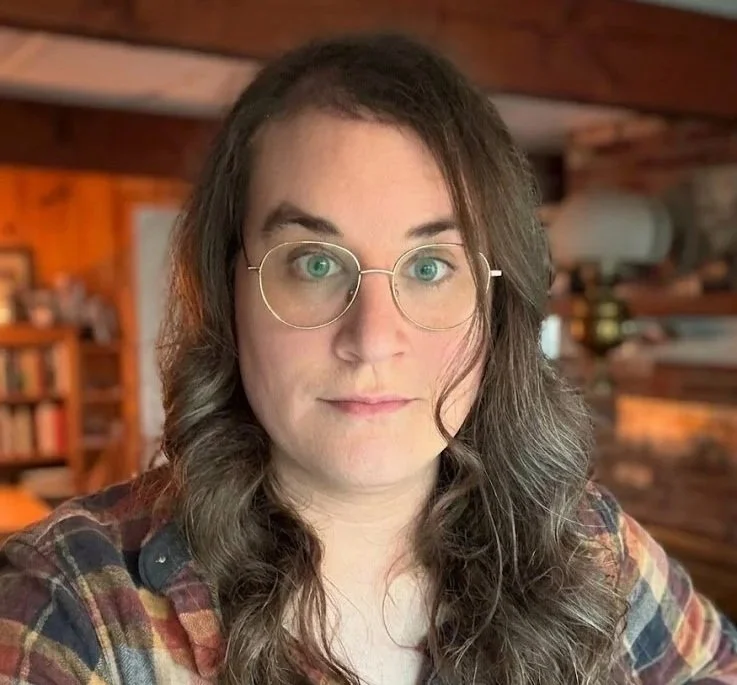
Ana Norton is a Canadian interdisciplinary sculptor whose practice investigates the structures that shape lived experience, working across digital fabrication and traditional casting techniques. Blending 3D printing with metal casting, Norton creates hybrid forms that traverse the virtual and physical, using material transformation to examine how systems—social, cultural, and material—inform identity and perception.
A graduate of OCAD University’s Sculpture and Installation program (2012), Norton is currently completing a low-residency MFA at Emily Carr University of Art + Design. Her work is grounded in a hybrid methodology that “queers” objects through both digital and physical processes, translating familiar forms into altered states that reveal the often-invisible frameworks governing everyday life.
Central to Norton’s practice is an inquiry into how structures—such as gender, space, and social organization—are constructed, internalized, and maintained. Drawing from her lived experience as a trans woman, she approaches identity not as fixed, but as something negotiated within and against these systems. Her sculptures examine how objects carry the imprint of the structures that produce them, and how shifting context or form can expose, disrupt, or reconfigure those underlying frameworks.
By moving objects between digital environments and physical materiality, Norton creates works that function as both artifacts and interventions. These forms challenge binary thinking and invite viewers to consider how meaning is shaped through context, classification, and use. In doing so, her practice opens a space for reflection on how structures both organize and constrain our understanding of the world.
Norton’s work resonates with collectors and curators interested in contemporary sculpture that engages critically with identity, technology, and systems-based thinking. Her practice positions her within a growing field of artists who are redefining materiality and authorship in an increasingly hybrid, post-digital landscape.
Artist Statement:
Structures are useful. They help us to parse complex information into easily understood patterns. We use structure to comprehend infinities: Material structure defines the space we live in — country, city, house, bedroom, kitchen etc.— in an infinite universe. We also apply structures to people. We use the structures of wealth, heritage, politics, gender, etc. to divide people ideologically into groups that are easier to understand, based on their relationships to other members of the structure. These too are useful structures, but in Sara Ahmed’s words, “What’s the use?”*
Choosing to live outside of the dominant binary structure of gender has changed the way I observe and experience the world. My position and perspective changed, and with them, my reality. The way the world treated me also changed; spaces that were once comfortable became hostile. This hostility at my subversion of the structure made me aware of my former subjugation to it: A subjugation into easily defined relations within a coercive structure (sex assigned at birth = gender = performed role in society). I grew aware that my body was marked. My gender was, and is, imposed upon me: the infinite spectra of identity and expression reduced to a binary structure. I crossed an invisible boundary, and in doing so forfeit my citizenship to that structure.
This awareness of one such structure has given me a lens to see others. To define and enforce structures is to mediate how we experience reality and deny those realities that exist beyond simple definition. Put plainly, through my work I ask, “How do structures affect us?” and “Can we change them?”
I am looking for the effects of structures on objects, and how those objects reflect structures. My research is asking “Can we see the effects of structures within the objects around us?” and “Does moving those objects into the structure of “Fine Art” create a window through which other structures become visible?”
To me it feels natural to look at the things we make and buy and build and own to see reflections of the structures we inhabit. If structures are reflected in the objects within
them, what happens when you remove the object from the structure? If it’s brought into a different structure, does it become marked? Does it interrupt the pattern of its new environment? Does it allow us to more clearly see the structure it came from?
*Sara Ahmed, What’s the Use? On the Uses of Use (Duke university press, 2019).
For images and acquisition details, please contact us.

Ana Norton. Turbulence, 2025 cast aluminum 12" x 12" $750

Ana Norton. Ritual, 2024 acrylic and resin on plywood 24" x 36" $2,000

Ana Norton. Anti-Bananas, 2026 oil on 3D printed plastic 6" x 6" x 8" $700

Ana Norton. Milk, 2026 oil on MDF 11" x 11" $300

Ana Norton. I think this is car parts?, 2025 metal, plastic, rubber, wood, acrylic paint 10" x 10" x 10" (Varies with installation) $1,000

Ana Norton. Ritual, 2024 cast aluminum 6" x 6" $150

Ana Norton. Bins, 2026 3D printed plastic 6" x 6" x ~8' (Varies with Installation) $500

Ana Norton. Medals, 2026 Sculling Oar, Rowing medals, ribbon, acrylic ~6' x ~4' x 6" (Varies with installation) $2,000