
Joan Miró
(b. Catalan, Spain, 1893–1983)

Joan Miró. Star, 1972 Lithograph XXIV/LXXX Signed bottom right 22" x 24" $7,000
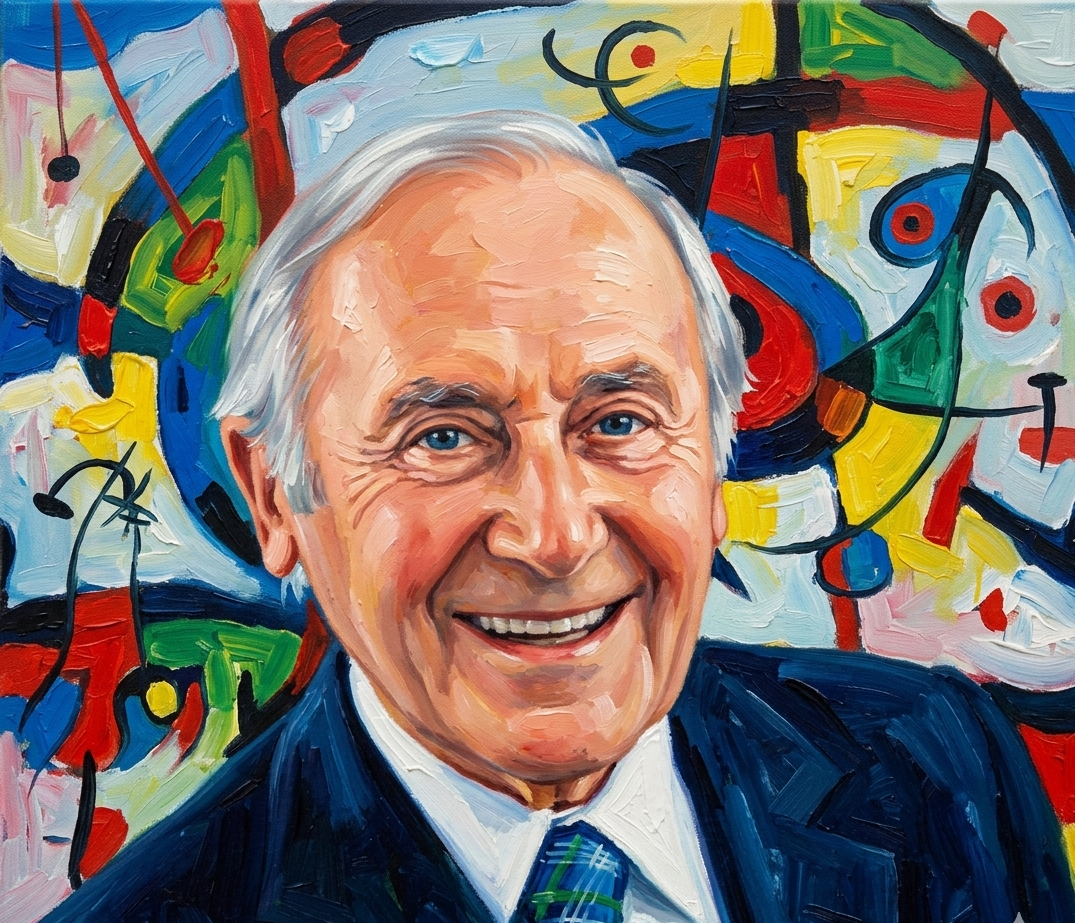
For collectors, the work of Joan Miró represents an opportunity to acquire art by one of the most influential innovators of twentieth-century modernism. Miró’s imaginative visual language—defined by floating biomorphic forms, calligraphic lines, and expansive fields of vibrant color—helped transform the direction of modern art. Positioned historically between Surrealism and abstraction, his work bridged European avant-garde movements and the rise of postwar abstraction, influencing generations of artists including Jackson Pollock, Mark Rothko, and Alexander Calder. Today his paintings, sculptures, ceramics, and prints are held in the world’s most important museums and collections, making Miró a central figure for collectors interested in historically significant modern art.
Miró was born in 1893 near Barcelona in the Catalan region of Spain. From an early age he demonstrated a talent for drawing, though his parents initially encouraged him toward a more practical career. After attending business school and briefly working as an accounting clerk, he suffered a serious illness brought on by exhaustion. During his recovery at the family farm in Mont-roig, he was allowed to pursue painting fully. He enrolled at the La Llotja School of Fine Arts in Barcelona and later studied at the progressive Academy Gali, where experimental teaching methods encouraged individual expression and unconventional approaches to drawing.
Catalonia’s landscape, folklore, and artistic traditions remained central to Miró’s imagination throughout his life. He was deeply influenced by the Romanesque frescoes preserved in the Museum of Catalonia, whose flat compositions, bold outlines, and primary colors helped shape his distinctive pictorial language. Catalan folk art, decorated pottery, and the rural environment surrounding his family’s farm also contributed to the symbolic vocabulary that would later appear in his paintings as birds, stars, insects, and playful human forms.
In his early artistic development Miró absorbed the lessons of modern European painting, studying the work of artists such as Paul Cézanne, Claude Monet, Édouard Manet, and Vincent van Gogh. The bold color of Henri Matisse and the structural innovations of Cubism also influenced his early work. Between 1915 and 1918 he produced nudes, portraits, still lifes, and landscapes, gradually simplifying forms and experimenting with color independent of natural appearance.
A decisive moment in his career came in 1919 when he traveled to Paris, where he visited the studio of Pablo Picasso and encountered the vibrant international avant-garde. Paris soon became one of three key places in his life—alongside Barcelona and the rural setting of Mont-roig. Immersed in the intellectual atmosphere of the city, he met artists and writers connected to Dada and the emerging Surrealist movement, including Francis Picabia and Tristan Tzara. These encounters encouraged Miró to move beyond traditional representation and toward a more symbolic and imaginative visual language.
During the early 1920s his work underwent a dramatic transformation as he began exploring dream imagery and the unconscious mind, influenced by Surrealist writers such as André Breton. One of the defining works of this period is The Farm (1921–22), an intricately detailed depiction of his family’s property in Mont-roig. Soon afterward he simplified his imagery further, creating rhythmic compositions filled with symbolic figures and animated forms. This development culminated in Harlequin’s Carnival (1924–25), a playful and dynamic painting that became one of the defining images of Surrealism. Although Miró exhibited with the Surrealists, he maintained an independent artistic identity and never formally joined the movement.
Throughout the late 1920s and 1930s Miró experimented widely with collage and unconventional materials, incorporating objects such as string, nails, and fragments of printed imagery. These explorations allowed him to break away from traditional painting methods and deepen his interest in chance, spontaneity, and symbolic imagery.
The political upheavals of the 1930s, particularly the Spanish Civil War, influenced the emotional tone of his work. In 1937 he created the mural The Reaper for the Spanish Pavilion at the Paris International Exposition of 1937, where it appeared alongside Pablo Picasso’s powerful antiwar painting Guernica.
During the early 1940s, amid the turmoil of the World War II, Miró produced one of his most celebrated bodies of work, the Constellations series. These intricate compositions of stars, figures, and delicate lines floating across luminous backgrounds conveyed a sense of cosmic poetry and spiritual escape during a time of global conflict. In 1941 the Museum of Modern Art in New York presented a major retrospective of his work, bringing him widespread international recognition.
After the war Miró increasingly expanded his practice beyond painting. He collaborated extensively with the ceramicist Josep Llorens i Artigas, producing innovative ceramic sculptures and monumental mural works. Their celebrated ceramic mural for the headquarters of UNESCO in Paris earned the Guggenheim International Award in 1958. During these decades Miró also explored sculpture using found objects cast in bronze, as well as extensive experimentation in printmaking, including lithography, etching, and carborundum engraving.
Miró’s influence on postwar art was profound. His expansive compositions and symbolic forms inspired artists associated with the New York School, including Robert Motherwell, Willem de Kooning, and Jackson Pollock. His work helped open the path toward Abstract Expressionism and later developments in contemporary art.
Deeply committed to his Catalan heritage, Miró helped establish the Fundació Joan Miró in Barcelona in 1972 to preserve his work and support contemporary artistic practice. The museum opened in 1976 and today houses one of the most comprehensive collections of his paintings, sculptures, drawings, and prints.
Miró died in 1983 at the age of ninety, leaving behind an extraordinary legacy that continues to shape the history of modern art. His imagery—at once playful, poetic, and deeply symbolic—draws from dreams, memory, and nature. For collectors and scholars alike, Miró’s work represents a powerful synthesis of imagination and innovation that helped redefine the possibilities of twentieth-century artistic expression.
Collector’s Perspective:
For collectors, the work of Joan Miró represents an opportunity to acquire art by one of the most influential figures of twentieth-century modernism. Positioned between Surrealism and abstraction, Miró developed a poetic visual language of biomorphic forms, expressive line, and vibrant color that helped shape postwar art. His innovations influenced major artists including Jackson Pollock, Mark Rothko, and Alexander Calder, making his work historically significant as well as visually distinctive.
Miró’s extensive production of prints, ceramics, and sculpture—alongside his paintings—has created a diverse and accessible market for collectors. His prints, in particular, offer an important entry point into collecting works by a museum-level artist whose pieces are held in major institutions such as the Museum of Modern Art and the Solomon R. Guggenheim Museum. Supported by continued scholarship and the legacy of the Fundació Joan Miró in Barcelona, Miró’s work remains highly regarded internationally, making it a compelling acquisition for collectors interested in the history and evolution of modern art.
For images and acquisition details, please contact us.