
TOM MATHEWS
(1920–2000)
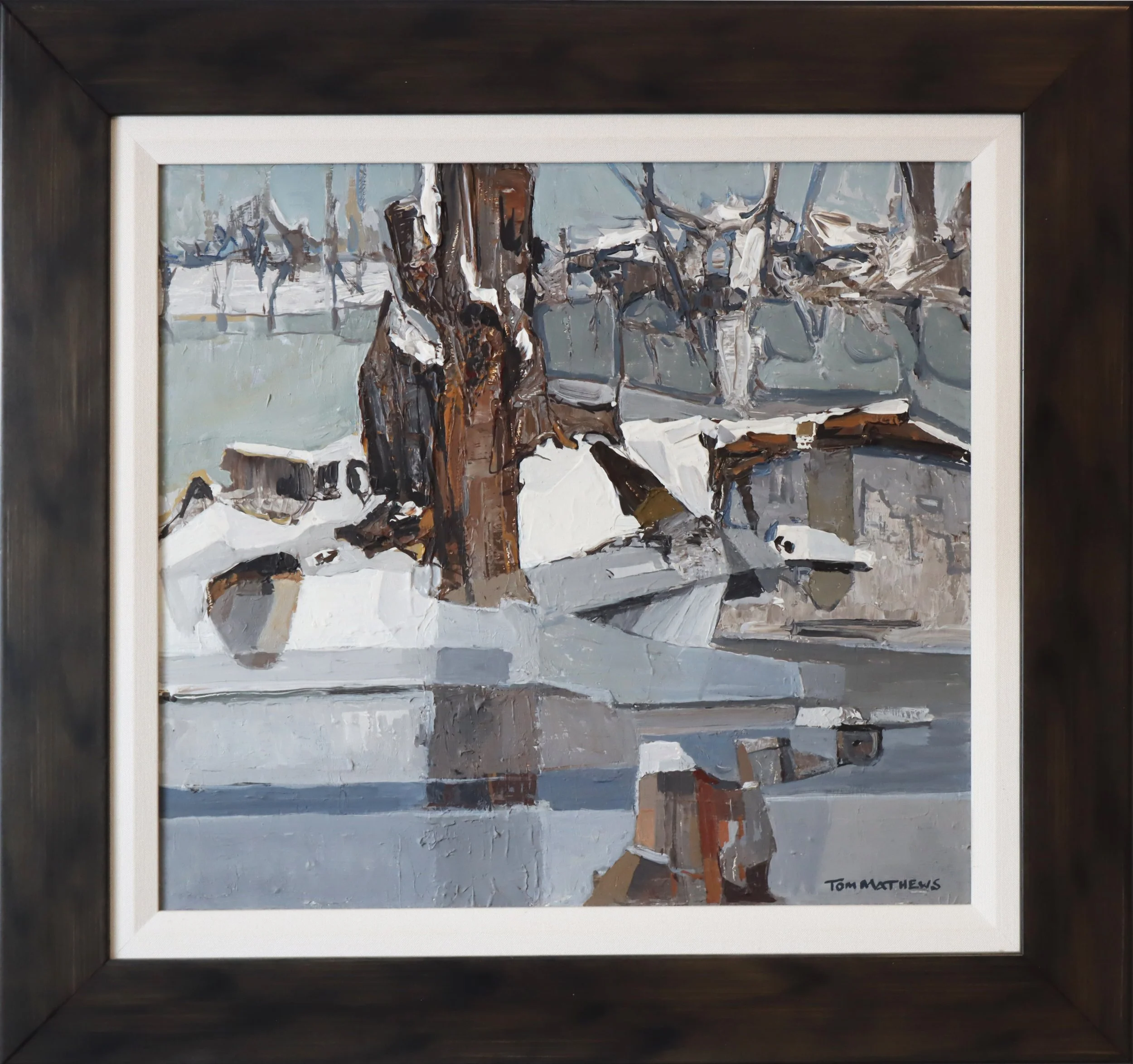
Tom Mathews. Ice Reflection n.d. oil on board 23.5" x 25" $3,500.00

For collectors of Canadian regional landscape painting, Tom Mathews (1920–2000) represents a well-trained mid-century professional whose work offers both visual appeal and historical grounding. Based in Brampton, Ontario, Mathews devoted nearly four decades to painting the rural landscapes of Peel County at a time when the region was undergoing rapid transformation. While not a nationally canonized figure, his work circulated widely through commercial galleries, art loan societies, and regional institutions, giving his paintings a durable presence in today’s secondary market.
Born in Montreal in 1920, Mathews received formal training from 1936 to 1939 at the École des Beaux-Arts de Montréal and the Montreal Museum of Fine Arts School. He also studied privately with several local art masters, culminating with Jacques de Tonnancour, RCA. This academic and mentorship-based foundation established his strong command of drawing, composition, and colour.
Alongside his fine art practice, Mathews worked professionally in the graphic arts as a newspaper illustrator, display designer, and fine art lithographer. This commercial experience reinforced the technical precision and compositional clarity evident throughout his paintings. He worked confidently in oils, acrylics, and watercolours, adapting each medium to different scales and effects.
After settling in Peel County in the mid-20th century, Mathews made the rural Ontario landscape his central subject. Farm fields, woodlots, and maple sugar bushes—one of his favourite motifs—appear repeatedly in his work, rendered with an impressionistic sensitivity to light and season. In 1959, he was elected to the Ontario Institute of Painters, affirming his professional standing, though he resigned in 1967. He exhibited widely through venues including the Port Credit Gallery, Oakville galleries such as Four Winds Gallery, Eaton’s Fine Art Galleries in Toronto, the Port Credit Art Loan Society, and the Peel County Museum and Art Gallery. He also participated periodically in Ontario Society of Artists exhibitions.
One of Mathews’ Peel County landscapes was selected for display at Ontario House in London, England, where it served as a representative example of Ontario’s regional culture abroad.
Although Mathews taught art for approximately seven years, he ultimately left teaching to focus on painting full time, maintaining a steady studio practice while remaining connected to the graphic arts industry. In his later career, he developed a personal pointillist technique, using small, dot-like brush marks reminiscent of post-Impressionist methods, adapted to Ontario landscapes. While primarily a realist and Impressionist painter, he occasionally explored abstract impressionism, with works such as Landscape Motif (c. 1985) noted by dealers as particularly successful departures.
Mathews lived and worked in Brampton until his death in 2000. Today, he is recognized as a listed Canadian artist, with works appearing at auction and in gallery inventories. Secondary-market values remain modest—typically in the low hundreds of Canadian dollars—making his paintings accessible to collectors seeking historically grounded, well-crafted regional Canadian landscapes.
Collector’s Note:
Tom Mathews occupies a meaningful place within the continuum of Canadian landscape painting, particularly for collectors interested in the enduring legacy of the Group of Seven and its long influence on regional artists. Mathews career reflects a sustained commitment to the same foundational idea: that the Canadian landscape—specifically Ontario’s fields, forests, and rural settlements—deserved painterly attention. He stands as part of the extended lineage of artists who carried forward the landscape tradition, maintaining its relevance in a changing province
Working primarily in Peel County from the 1950s through the 1990s, Mathews documented a region undergoing rapid transformation. In this sense, his paintings function not only as aesthetic objects but as historical records of a disappearing rural Ontario. For collectors, this documentary quality adds depth and resonance. Much as the Group of Seven fixed northern wilderness imagery into the national imagination, Mathews preserved the agrarian character of southern Ontario at a pivotal moment of suburban expansion. His maple sugar bushes, farmhouses, and winter fields carry both visual charm and cultural memory. Prices are generally accessible compared to nationally canonized figures, which makes his work attractive to collectors building thoughtful Canadian landscape holdings without entering the higher-priced segments associated with major historical names.