
Les Plasticiens: Finding Direction Beyond the Revolt
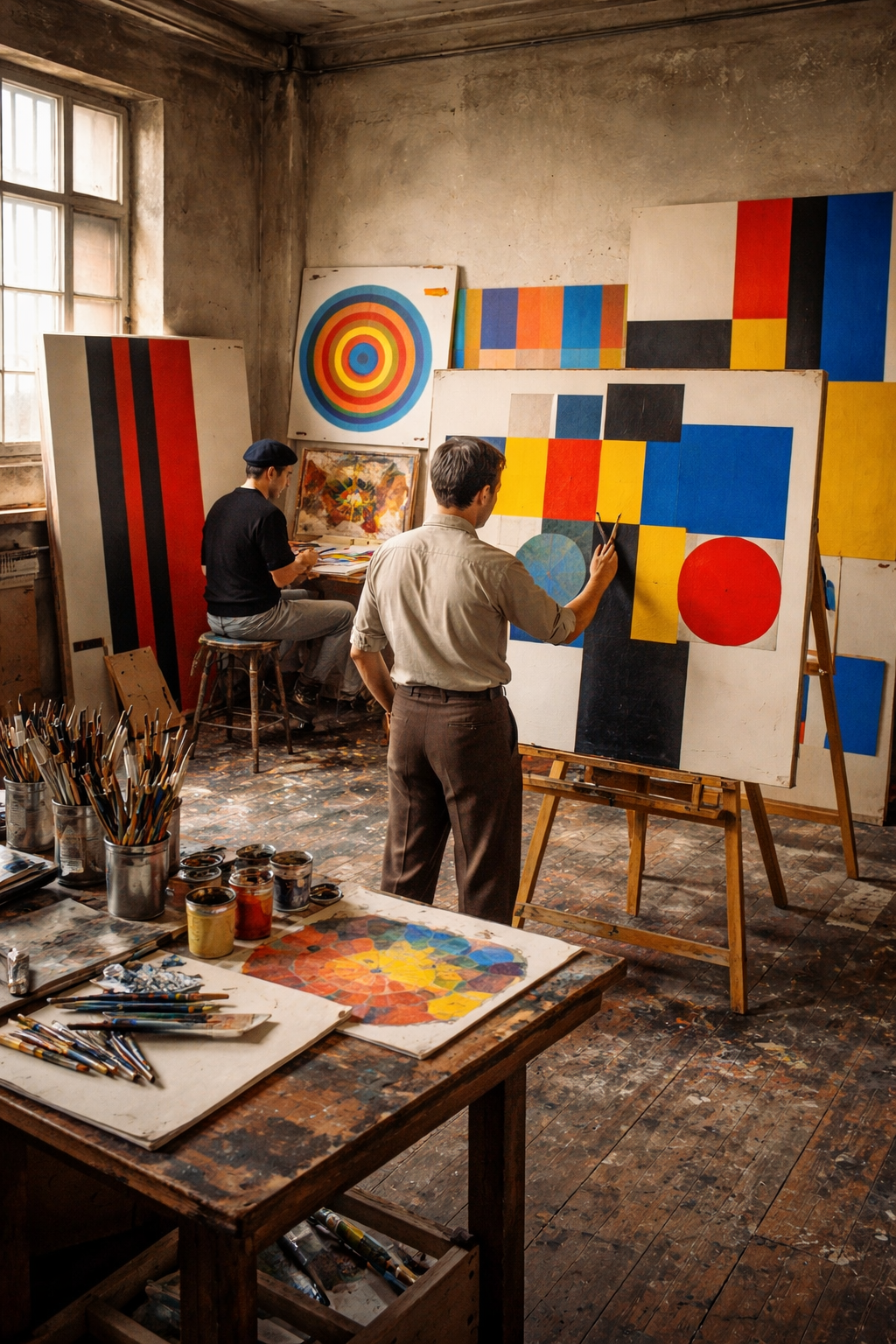
The Plasticiens emerged in the mid-1950s at a moment when artistic freedom had already been forcefully claimed by Les Automatistes. Refus global had shattered the hold of tradition, censorship, and obedience, opening the door to abstraction as an act of liberation. But once that initial barrier had been broken, a new question emerged: what comes next?
For the Plasticiens, the answer was not more gesture or emotional release, but clarity, structure, and intention. They understood the Automatiste revolt as a vital springboard—one that made it possible to think beyond rebellion rather than simply repeat it. To continue painting with the same gestural language risked turning rupture into habit; to advance art required a fresh direction.
Choosing geometry over spontaneity, structure over impulse, the Plasticiens reimagined abstraction as a discipline rather than an escape. Their paintings were not expressions of the subconscious but carefully constructed objects, governed by relationships of colour, line, and surface. In rejecting automatist gesture, they were not retreating from freedom; they were redefining it—asserting that precision, restraint, and proportional clarity could be as radical as improvisation itself.
This shift was an act of independence. To move away from Automatism was to disagree with a movement that had only recently been revolutionary and to argue that artistic freedom must include the freedom to change course. Painting became a site of decision-making, where every element mattered and nothing was arbitrary. In this sense, the Plasticiens remind us that direction matters more than style: art advances not by clinging to rupture, but by artists willing to ask new questions once barriers have fallen.
Montreal in the 1950s–60s: A Laboratory for Freedom and Order
To understand the significance of this transformation, it helps to see Montreal itself as a kind of laboratory—where freedom, order, and modernity were being negotiated in real time against the backdrop of powerful social constraints.
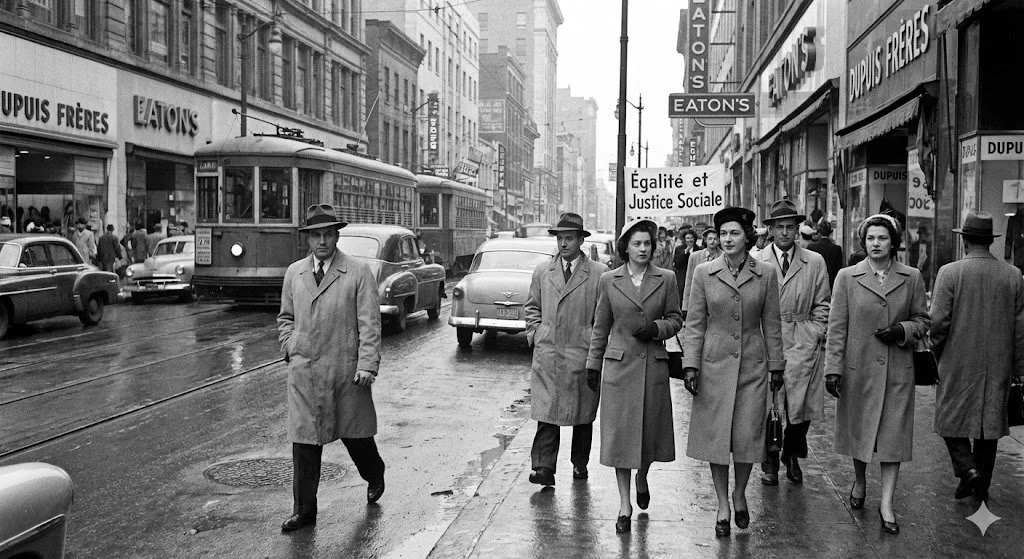
In the mid-1950s, Quebec was still under the control of Premier Maurice Duplessis, whose conservative, clerically aligned regime came to be known as la grande noirceur. The Catholic Church exerted enormous influence over education, health care, and cultural life, while legal tools like the Padlock Act suppressed anything deemed “subversive.” In this climate, both Automatistes and Plasticiens found themselves considered suspect, loosely aligned with ideas that threatened the cultural authorities of the day.
But Montreal was also industrializing, urbanizing, and intellectually restless. The city’s art-going public, small galleries, cafés, and informal networks provided spaces where artists could push boundaries—even if official institutions lagged behind. This tension between constraint and experimentation made Montreal uniquely fertile ground for abstraction to develop in distinct and unexpected directions.
By the time Duplessis’s regime fell and the Quiet Revolution began in the 1960s, Quebec was undergoing a rapid shift toward secularization, state-led modernization, and francophone cultural assertion. State institutions expanded into education, health care, and culture, displacing clerical control and opening new opportunities for artistic production, exhibition, and discourse. In this changing environment, the rigorous abstraction of the Plasticiens found a more receptive public framework, and Montreal increasingly became recognized as a centre for geometric and colour-field art within Canada and beyond.
Challenging the Movement from Within: Molinari, Tousignant, Gaucher
Movements stay alive only when they are challenged from within, and the Plasticien current was no exception. The second generation of artists associated with the movement—most notably Guido Molinari, Claude Tousignant, and later Yves Gaucher—pushed its ideas further, deepening and intensifying the logic of geometric abstraction.
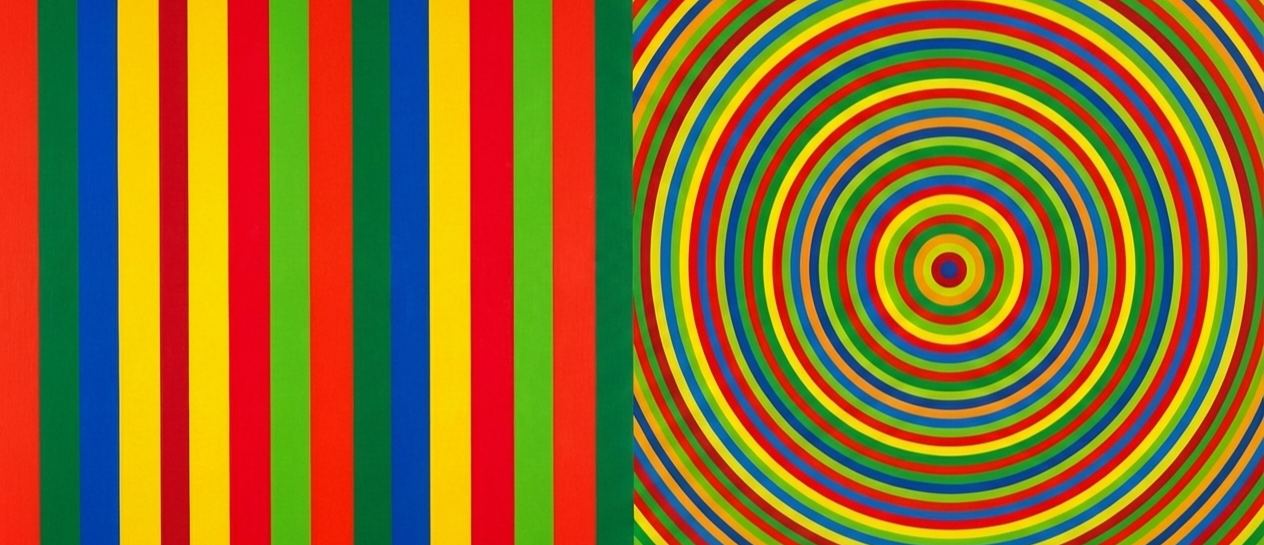
Molinari, in particular, was outspoken in his critique of the first Plasticiens as too timid. His vertical stripe paintings are emblematic of a bolder, more systematic approach to colour and form—where rhythm, repetition, and contrast become the primary subject. Molinari’s work moved beyond the manifesto’s initial formulations, insisting that geometry could not be merely ordered, but operational—affecting perception as much as structure.
Claude Tousignant, best known for his concentric circle works, took a related but distinct path. His use of intense, flat colour fields and optical relationships created paintings that were at once serene and dynamic, inviting viewers into an immersive perceptual experience. Where the first Plasticiens focused on structural clarity, Tousignant foregrounded the felt dimension of colour itself—acknowledging that geometry and sensation are not opposed, but inseparable in a mature abstraction.
Yves Gaucher, associated with later iterations of the movement, continued to rethink pictorial space and perception. His work often engaged with optical ambiguity and spatial tension, exploring how geometric forms and colour fields could expand, contract, and even contradict one another within a single composition. In doing so, Gaucher helped usher geometric abstraction into the broader international currents of hard edge and colour field painting while maintaining a distinctly Montreal sensibility.
A Legacy of Direction and Change
The story of Plasticiens shows that artistic evolution is not linear or uniform, but a conversation—a negotiation between past achievements and present sensibilities. The movement’s progression from revolt through structure to refinement reflects a broader truth: that artistic freedom finds its fullest expression not only in breaking chains, but in choosing what to build next.
The Plasticiens’ turn to geometric abstraction was not a retreat from the radical spirit of the Automatistes, but a reorientation of it. By insisting on order, clarity, and objecthood, they expanded what modernism could be in Canada and helped position Montreal as a vibrant centre of abstract thought. And in the work of later artists like Molinari, Tousignant, and Gaucher, we see that movements endure only when they are continually challenged, reinterpreted, and renewed from within.
