
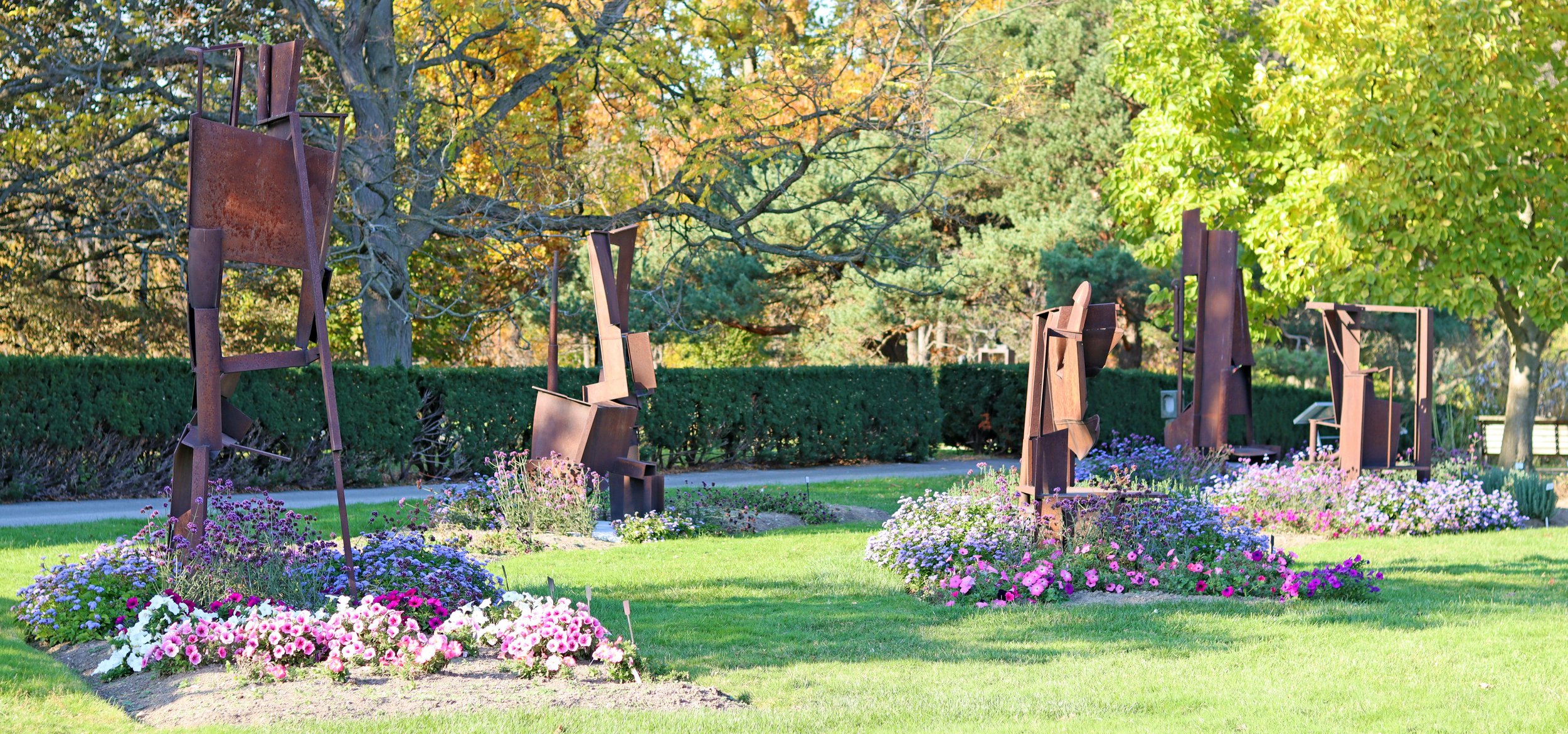
Walk toward the Iris Collection in Hendrie Park at the Royal Botanical Gardens (RBG) in Burlington, and you are greeted by a striking visual threshold: a towering, weathered steel sculpture standing just outside the garden beds, inviting you in. Step inside the Iris Collection itself, and five companion works rise directly from the perennial plantings. Together, these six monumental sculptures create an unforgettable dialogue between industrial geometry and living flora—their warm, rusted patinas and open frames catching the changing Ontario light and inviting visitors to look through the steel rather than simply at it.
Created by renowned Saskatchewan sculptor Douglas Bentham, this cohesive suite known as the Hardingham Series is the anchor of RBG’s newest permanent public art initiative, The Mann Family Sculpture Collection. Yet before these six monumental works found their forever home in Hendrie Park in August 2026, they embarked on a remarkable 36-year transatlantic and cross-country journey—from an English farm workshop to London galleries, the Canadian prairies, Niagara wine country, and finally, Burlington.
1. The Crucible: The Hardingham Sculpture Workshop (Norfolk, U.K.)
The story begins in 1990 in the quiet countryside of Norfolk, England, at Gresham Farm—home to the Hardingham Sculpture Workshop.
Modeled after intensive, peer-led international art movements like the Triangle Artists' Workshop and Western Canada’s famed Emma Lake Workshops, Hardingham was designed as a working trust rather than a commercial retreat. It offered invited sculptors dedicated studio grounds, heavy fabrication equipment, and the rare luxury of uninterrupted focus alongside international peers.
When Douglas Bentham arrived at Hardingham in 1990, stepping away from his established studio practice in Saskatchewan, the environment sparked an extraordinary creative burst. Over just 12 intensive days, Bentham worked directly with industrial steel to weld, assemble, and construct six monumental sculptures. Free from commercial gallery pressures and immersed in daily peer critique, he pushed his Constructivist vocabulary into bold new territory.
2. Anatomy of the Six: Exploring the Hardingham Series
Although each of the six works possesses its own distinct structural rhythm, they were conceived and built as a unified family. Standing well over six feet tall, with several reaching close to ten feet, the sculptures share a defining architectural grammar:
Constructivist Direct-Metal Assembly: Rather than casting solid, monolithic masses, Bentham welded and bolted planar steel plates, structural beams, and linear bars together.
Open Spatial Framing: Negative space is just as active as the steel itself. Open frames, cantilevered angles, and rhythmic vertical columns allow light, sky, and surrounding foliage to pass directly through the silhouettes.
Living Patina: Left to weather naturally and treated with oil, the steel surfaces developed deep, earthy tones of russet, umber, and charcoal that shift with rain, sun, and season.
The Six Works in the Suite
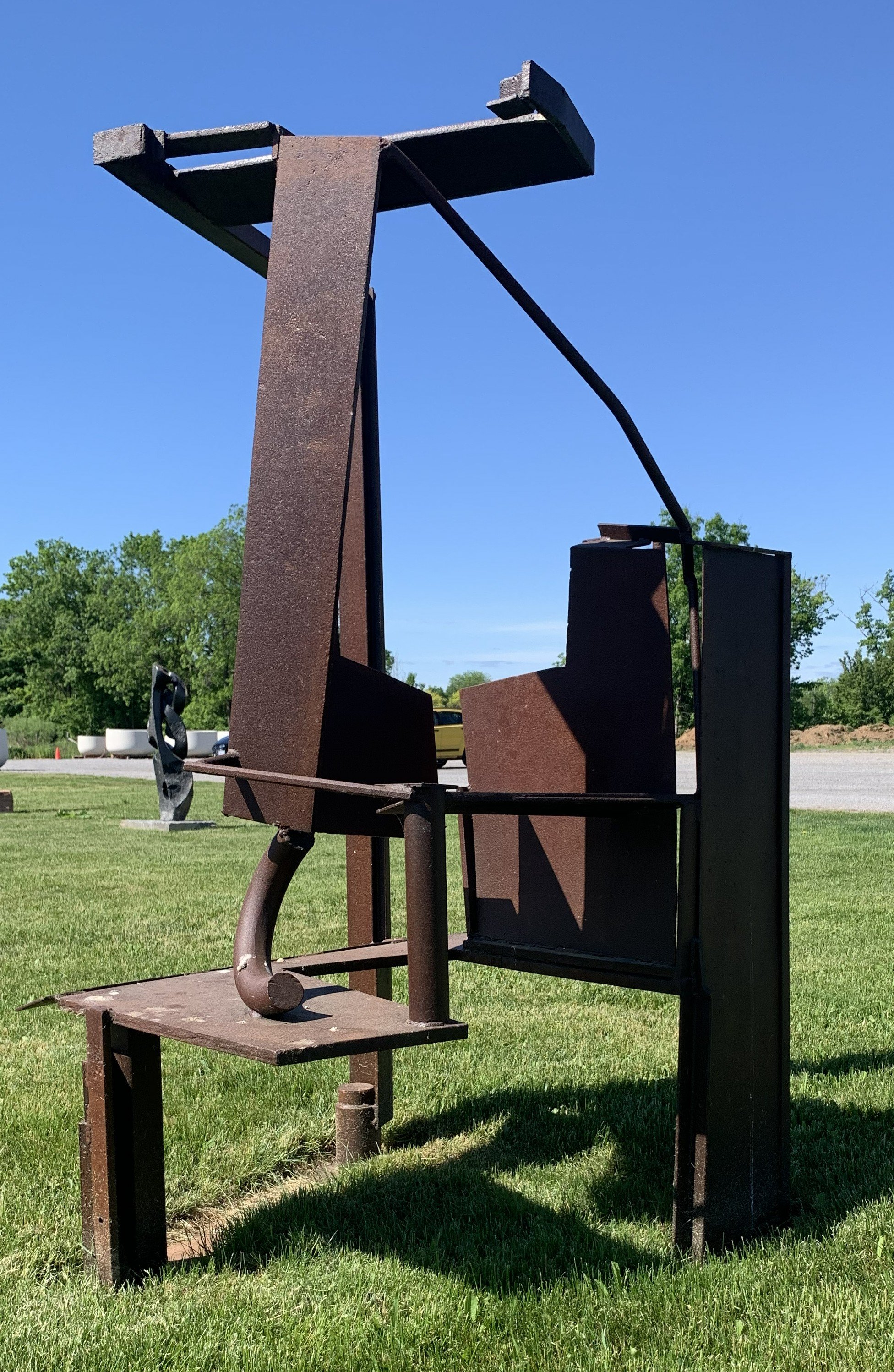
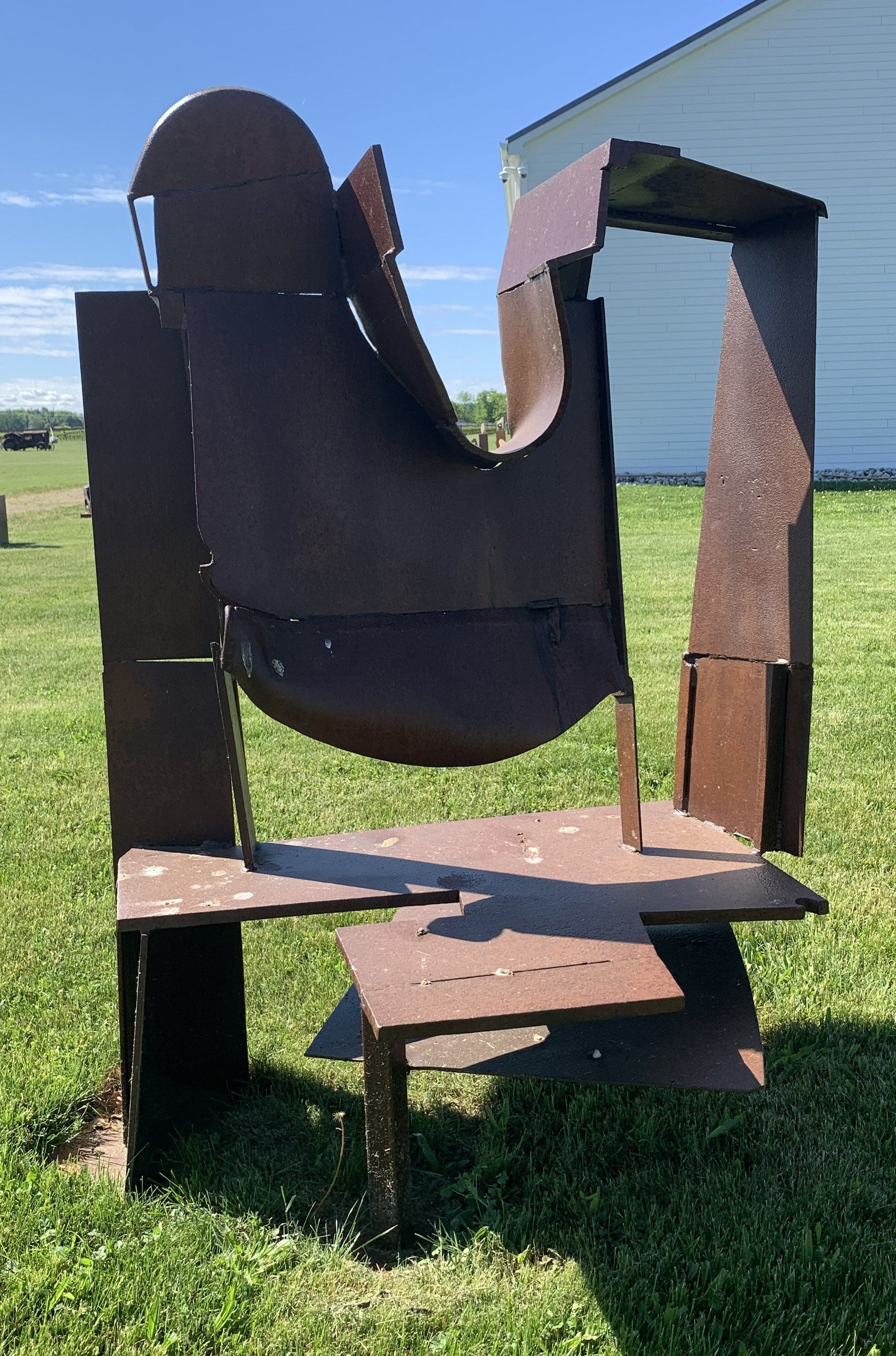
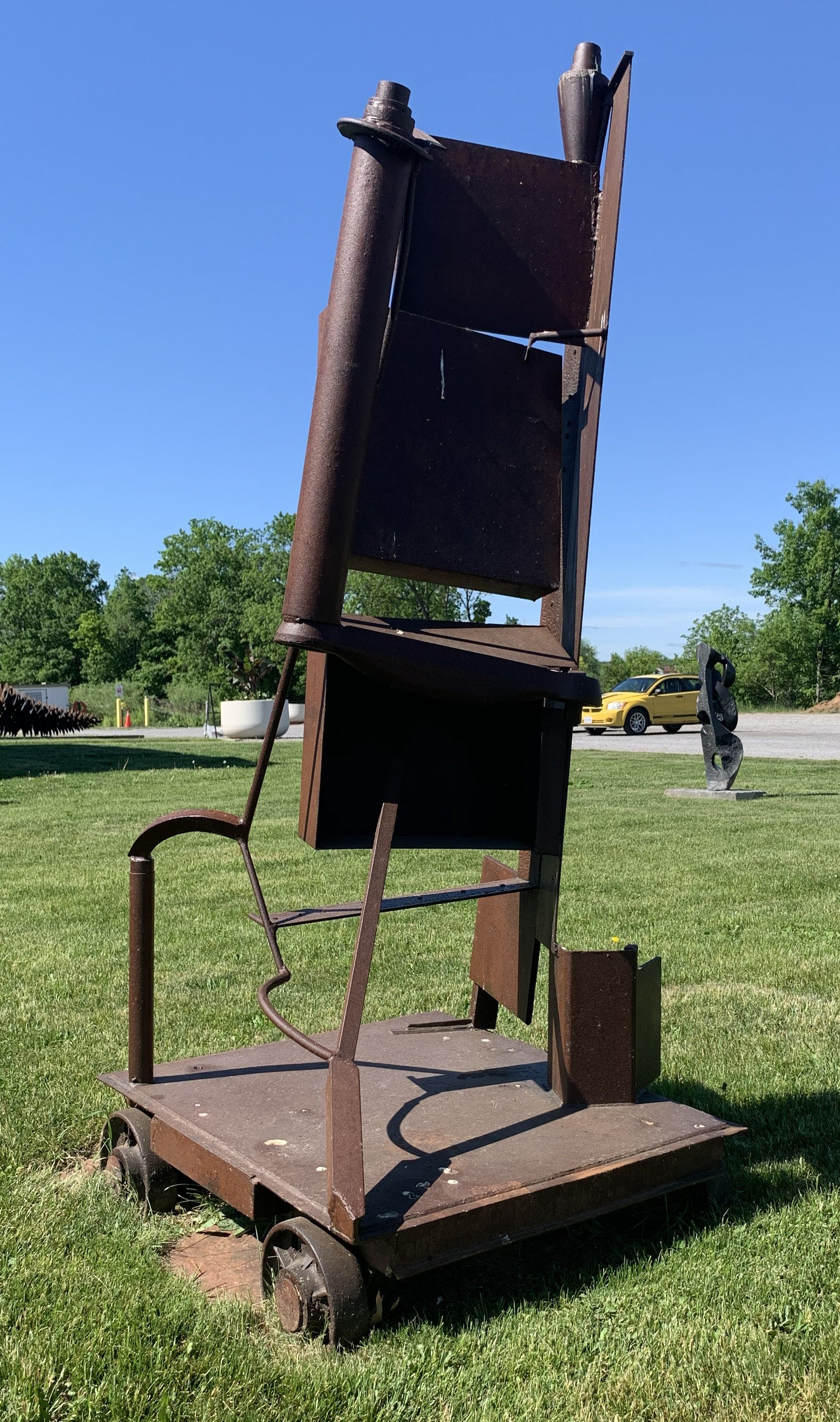
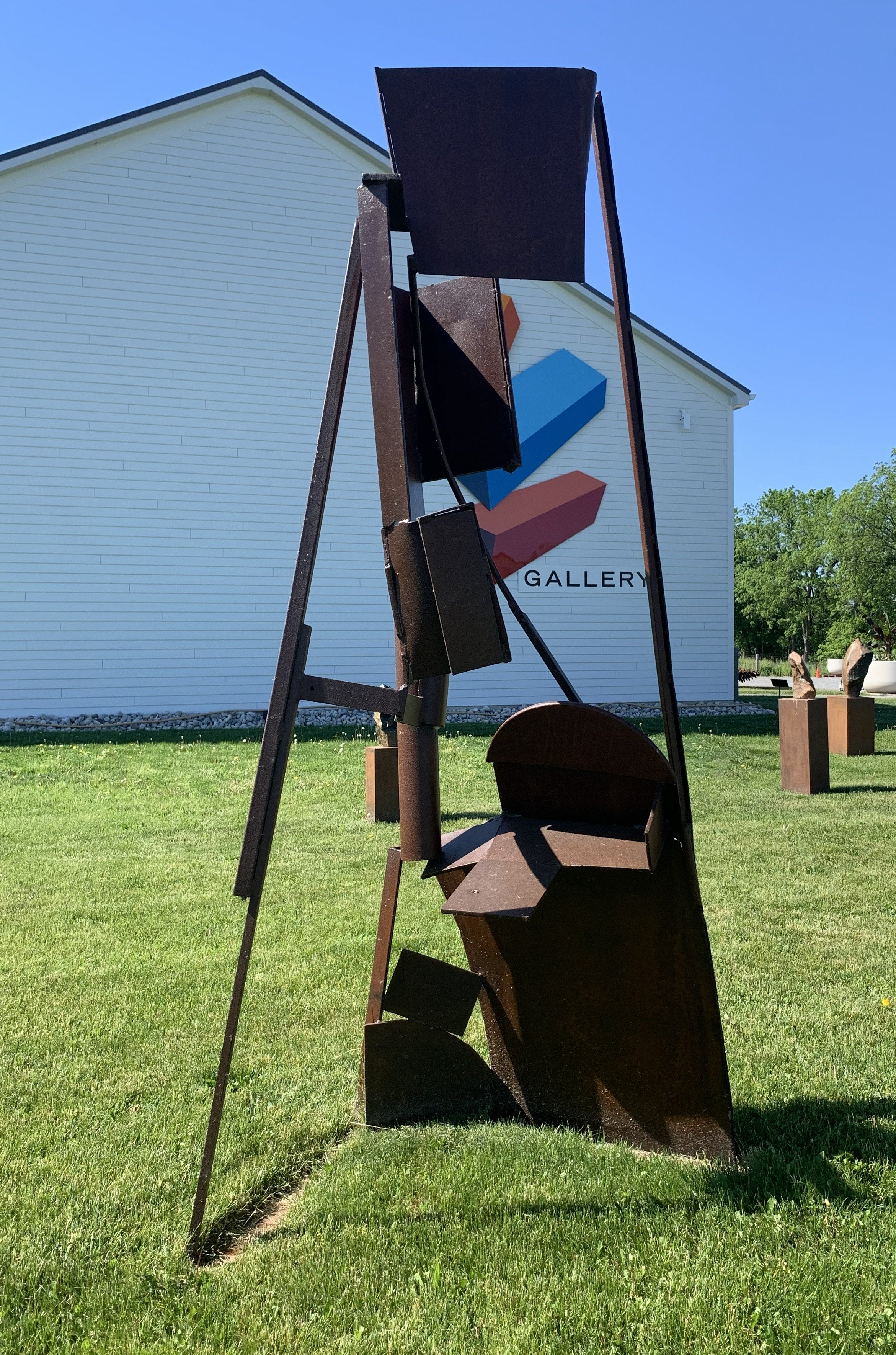
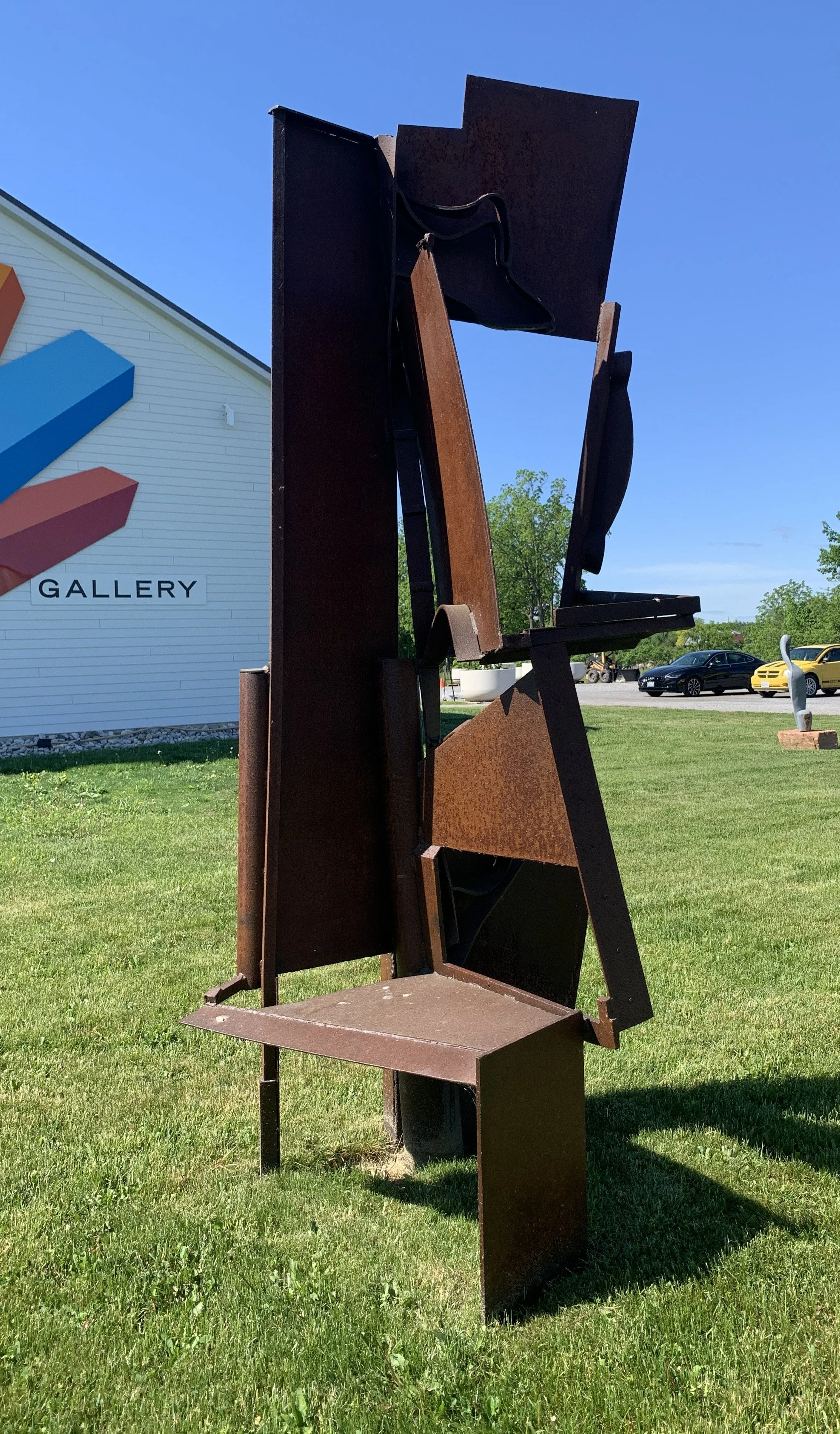
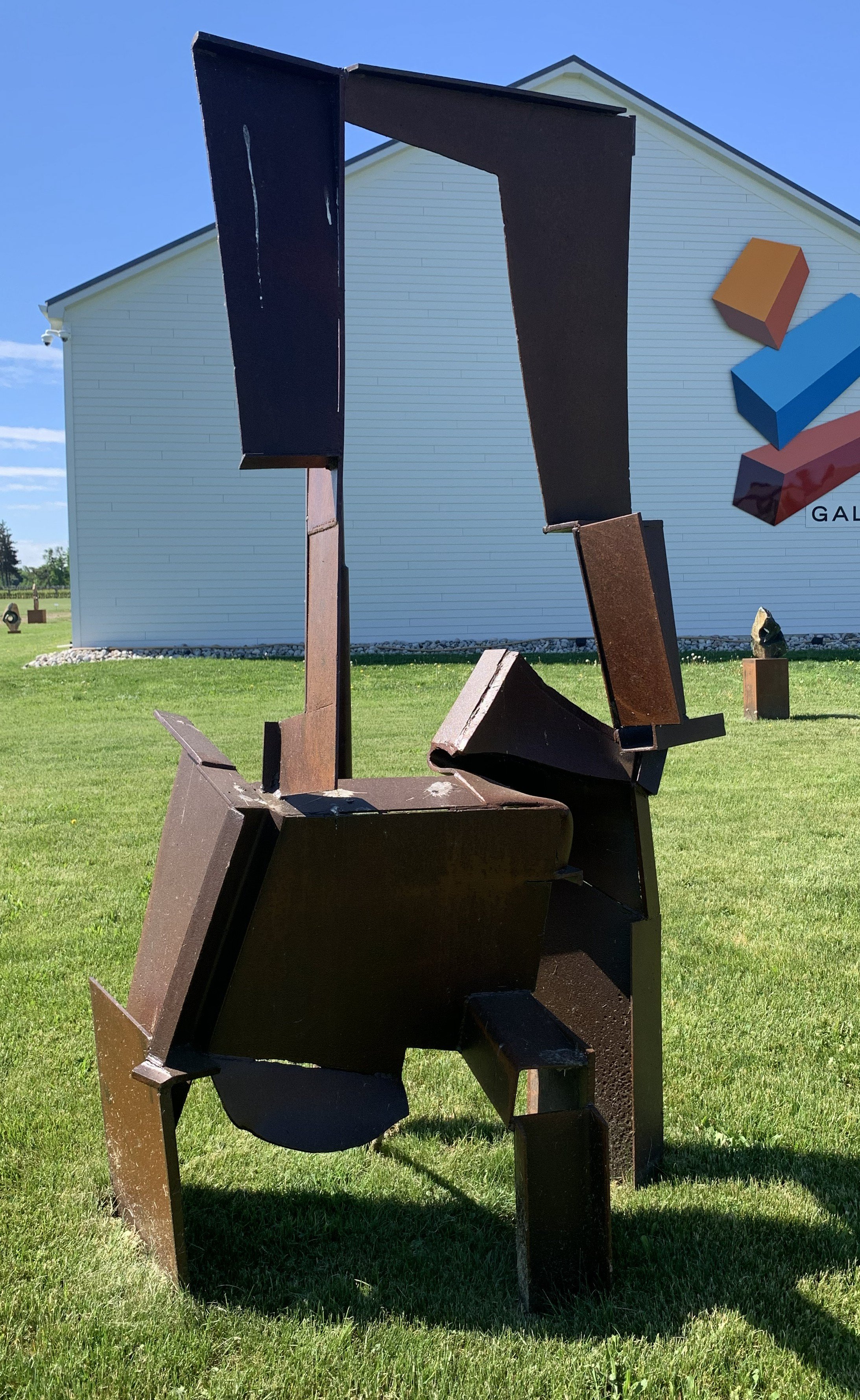
The six welded mild steel sculptures include: Hardingham Wish (72” x 46” x 36”), Hardingham Screen (71” x 50” x 34”), Hardingham Dream (96” x 41” x 39”), Hardingham Heights (111” x 58” x 44”), Hardingham Sonata (115” x 54” x 36”) and Hardingham Mirror (92” x 52” x 40”) - all dated1990
(Note: Following his return to Saskatchewan in 1990, Bentham also created a companion tribute piece in brass and bronze titled Hardingham Memory in honor of fellow sculptor John Foster—distinct from the six welded-steel works forged on-site in Norfolk.)
3. On the Road: Exhibitions & The Niagara Chapter
(1990–2026)
Unlike many series that are broken up and sold individually after creation, the six Hardingham steel sculptures remained together as an intact suite across three decades and two continents:
1990 — Norfolk, U.K.: Forged on-site at the Hardingham Sculpture Workshop, the works remained in the United Kingdom for nearly two decades following the residency.
September 2007 — APT Gallery (London, U.K.): The suite made a celebrated public appearance in Deptford, London, as the centerpiece of Bentham’s solo exhibition Crossing the Pond (September 20–30, 2007). There, the six weathered 1990 Hardingham works were exhibited alongside six newer stainless-steel sculptures from his Espalier series, highlighting the evolution of his material language.
March – April 2014 — Museum of Contemporary Art (MOCA, Calgary, AB): Following their return to Canada, the six works were featured in a dedicated solo exhibition titled The Hardingham Sculptures 1990 (March 6 – April 13, 2014), introducing Western Canadian audiences to the full Norfolk suite.
2014 – 2018 — Dundurn / Saskatoon, SK: Between institutional exhibitions, Bentham installed the six sculptures outdoors on the grounds of his rural acreage studio near Dundurn, Saskatchewan, where their oxidized steel stood in quiet dialogue with the open prairie horizon.
2018 – 2026 — 13th Street Winery (St. Catharines, ON): In 2018, the entire suite caught the eye of late St. Catharines business leader and passionate art patron John Mann (founder of Performance Cars and the John Mann Gallery). Recognizing the rarity of keeping a major 1990 suite intact, Mann acquired all six sculptures and shipped them to Niagara. For eight years, they stood among the vineyards of 13th Street Winery, anchoring its renowned outdoor sculpture collection and becoming familiar landmarks to wine-country visitors.
4. A New Sanctuary: RBG’s Sculpture Tradition &
The Mann Family Gift
In August 2026, the Hardingham Series entered its permanent chapter: joining a thriving outdoor art tradition at the Royal Botanical Gardens in Burlington. Outdoor sculpture at RBG took root in 2014 with the launch of the Dan Lawrie International Sculpture Collection (DLISC) in Hendrie Park. Founded through a landmark 10-year commitment by Hamilton businessman and philanthropist Dan Lawrie in 2013, the collection transformed RBG’s cultivated gardens into one of the region’s premier destinations for monumental public art, proving how powerfully contemporary sculpture resonates when surrounded by living landscapes.
Building on that foundation, The Mann Family Sculpture Collection was established in August 2026 through a generous gift from the estate of John Mann. Following John Mann’s passing, Dan Lawrie’s outreach initiated the transfer of the six Bentham sculptures to RBG, ensuring the works would stay together as an intact suite, remain publicly accessible, and be maintained in a permanent institutional setting.
A Permanent Placement at Hendrie Park
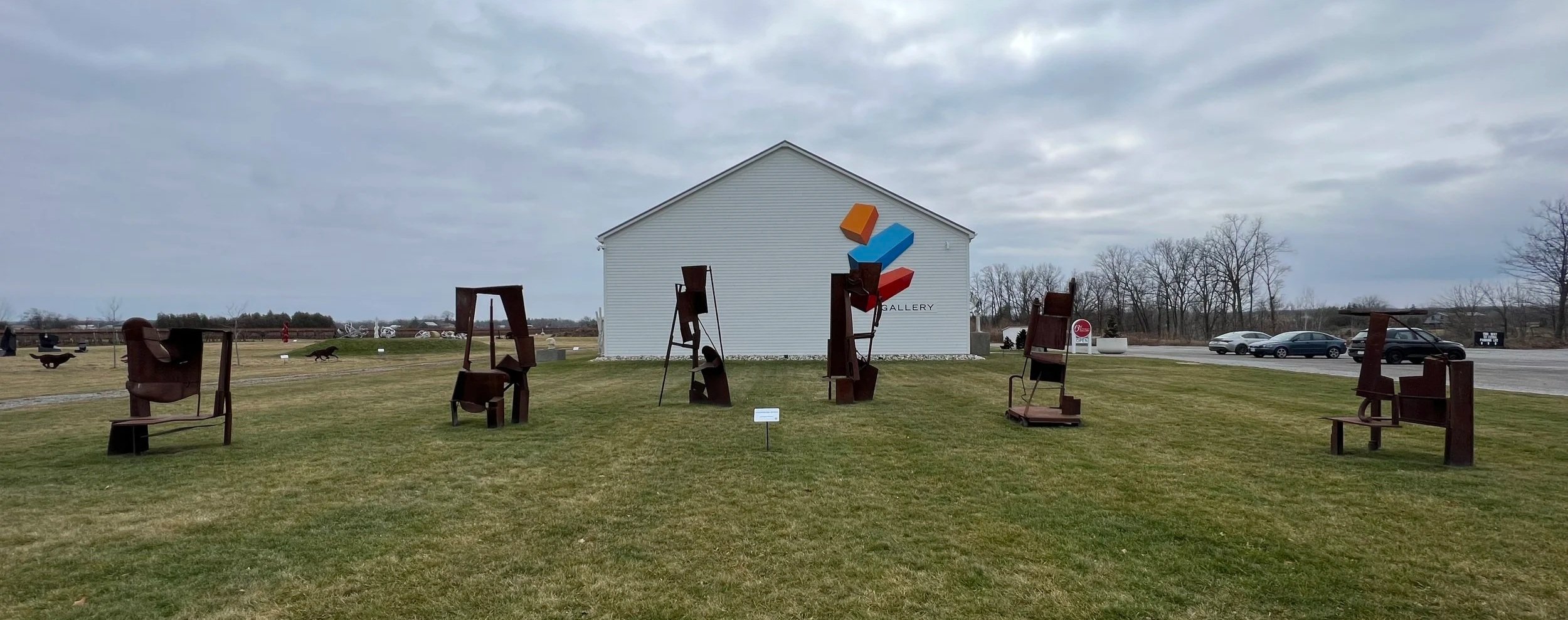
Installed in a thoughtful spatial arrangement at Hendrie Park, with one sculpture standing just outside the Iris Collection as a welcoming sentinel and the remaining five nestled directly within the garden beds, Douglas Bentham’s six Hardingham sculptures have come full circle. Born in the rural fields of Norfolk, tested in galleries from London to Calgary, rooted on the Saskatchewan prairies, and nurtured among Niagara’s vines, they now stand where seasonal blooms continuously transform how their rusted steel frames are seen.
Whether framed by vibrant spring irises, lush summer foliage, or winter snow, the Hardingham Series stands as both a milestone in Canadian Constructivist sculpture and a lasting tribute to visionary patronage.
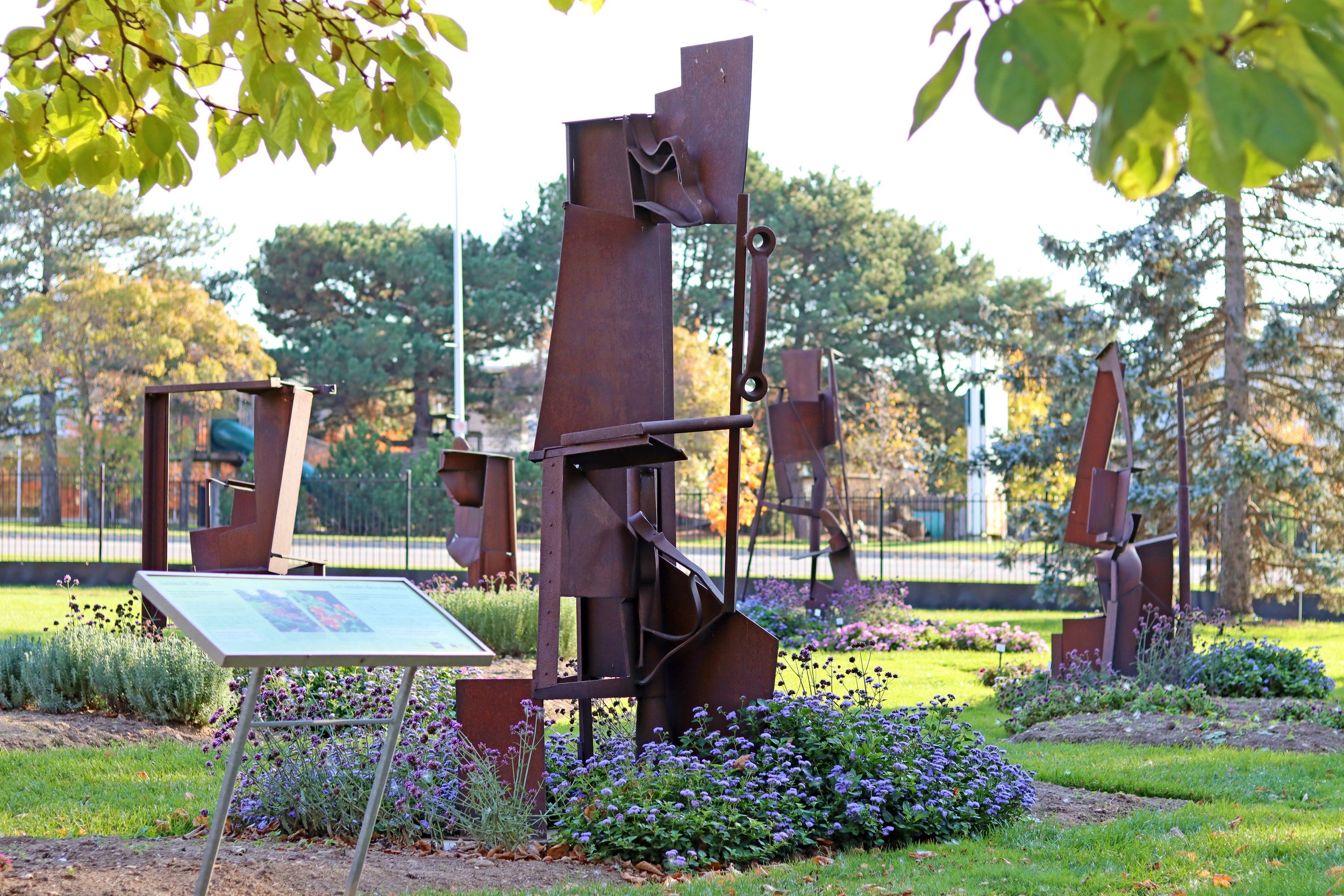
Douglas Bentham’s Hardingham Series in Hendrie Park among the Iris Collection at Royal Botanical Gardens in Burlington.
Popular Q&A
Where can you see Douglas Bentham’s Hardingham Series sculptures?
All six monumental sculptures from Douglas Bentham’s Hardingham Series (1990) are permanently installed in Hendrie Park at the Royal Botanical Gardens (RBG) in Burlington, Ontario. One sculpture stands just outside the Iris Collection as a welcoming sentinel, while the other five are integrated directly within the perennial iris beds.
What are the six sculptures in the Hardingham Series?
The suite consists of six welded mild steel sculptures created by Douglas Bentham in 1990:
Hardingham Wish (72” × 46” × 36”)
Hardingham Screen (71” × 50” × 34”)
Hardingham Dream (96” × 41” × 39”)
Hardingham Heights (111” × 58” × 44”)
Hardingham Sonata (115” × 54” × 36”)
Hardingham Mirror (92” × 52” × 40”)
(Bentham also created a separate companion tribute piece in brass and bronze titled Hardingham Memory upon returning to Saskatchewan in 1990.)
Where and when were the Hardingham sculptures made?
Saskatchewan sculptor Douglas Bentham welded and assembled all six mild steel sculptures over an intensive 12-day residency in 1990 at the Hardingham Sculpture Workshop, located at Gresham Farm in rural Norfolk, England.
What happened to the Douglas Bentham sculptures at 13th Street Winery?
St. Catharines art patron John Mann acquired the intact six-piece Hardingham Series in 2018 and installed the sculptures on the grounds of 13th Street Winery in Niagara, where they were displayed for eight years. In August 2026, following John Mann’s passing, the Mann Estate donated the complete suite to the Royal Botanical Gardens in Burlington so the works could remain together in a permanent public setting.
What is The Mann Family Sculpture Collection at the Royal Botanical Gardens?
Established in August 2026, The Mann Family Sculpture Collection is RBG’s second major permanent outdoor sculpture initiative in Hendrie Park, joining the Dan Lawrie International Sculpture Collection (founded in 2014). Anchored by the Mann Estate’s gift of Douglas Bentham’s six Hardingham sculptures—facilitated through outreach by philanthropist Dan Lawrie—the collection ensures major works of Canadian public art remain accessible to visitors year-round.
Where else has Douglas Bentham’s Hardingham Series been exhibited?
Since their creation in Norfolk, U.K. in 1990, the six sculptures have remained together as a unified suite and have been exhibited at APT Gallery in London, U.K. (Crossing the Pond, 2007), the Museum of Contemporary Art (MOCA) in Calgary, Alberta (The Hardingham Sculptures 1990, 2014), Bentham’s outdoor studio grounds near Dundurn/Saskatoon, Saskatchewan (2014–2018), and 13th Street Winery in St. Catharines, Ontario (2018–2026) prior to their permanent installation at RBG Burlington.
Who is Douglas Bentham?
Douglas Bentham (1947 - 2026 b. Rosetown, Saskatchewan) is one of Canada’s foremost contemporary Constructivist metal sculptors. Known for his large-scale, open-frame welded steel works that interact with light and surrounding landscapes, his sculptures are held in major public, corporate, and museum collections across Canada and internationally.
