James Baker Pyne
(1800 - 1870)


Artist: James Baker Pyne (1800 - 1870) BRITISH
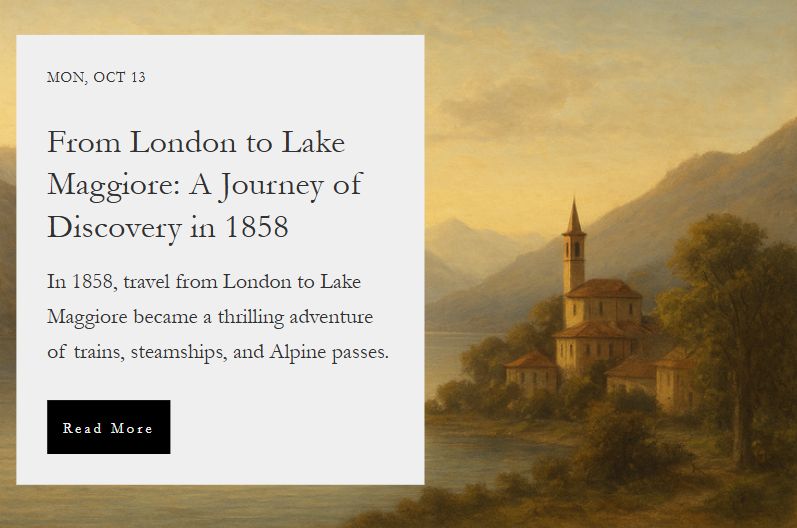
Title: Italian Coast Scene (Lake Maggiore, Baveno region), 1858
Media: oil on canvas
Size: 26” x 36”
Notes: signed and dated lower right,
CAN $5,000.00
Provenance:
Private Collector since 2015, Mississauga, ON
Private Collector, Toronto, ON
The Roberts Gallery, Toronto
Frost & Reed, London, England
Original resale price $450.00
This luminous Italian landscape exemplifies James Baker Pyne’s poetic command of light and atmosphere. Painted during his travels through northern Italy in 1846 and again after 1851, the scene likely depicts Lake Maggiore near Baveno—a subject Pyne returned to repeatedly for its serene grandeur and golden Mediterranean light. The composition unfolds with remarkable balance: a lakeside village animated by daily life in the foreground, calm waters reflecting alpine peaks in the distance, and a warm veil of light uniting nature and architecture in quiet harmony.
Blending British Romanticism with continental refinement, Pyne transforms this view into a meditation on beauty and transience. The composition’s subtle gradations of tone, from the sunlit facades to the misty mountains, reveal his sensitivity to nature’s shifting moods. Influenced by J. M. W. Turner yet distinctly his own, Pyne’s vision is grounded in quiet reverence and painterly control.
Collector’s Note: Recent auction results for James Baker Pyne’s Italianate landscapes reveal a strong and stable market for works from his mature period. Pallanza on Lake Maggiore (Christie’s, May 2023) achieved approximately CAD $65,000, marking one of the artist’s higher recent sales and underscoring collector interest in large, well-preserved compositions. Other examples include Isola Bella, Lake Maggiore, Italy (Christie’s, July 2016), which realized about CAD $14,000, and Lake Maggiore, Italy (Christie’s, 2000), which brought roughly CAD $5,700. Smaller or less ambitious canvases such as Figures by an Italianate Lake (Christie’s, 2002) have sold in the CAD $5,000–$6,000 range. Overall, Pyne’s Italian lake views—particularly those depicting Maggiore or Baveno—remain sought after for their luminous handling of light and Turneresque atmosphere. Well-composed, mid- to large-scale examples in good condition typically command CAD $10,000–$40,000, with exceptional works reaching higher prices when supported by provenance or exhibition history.
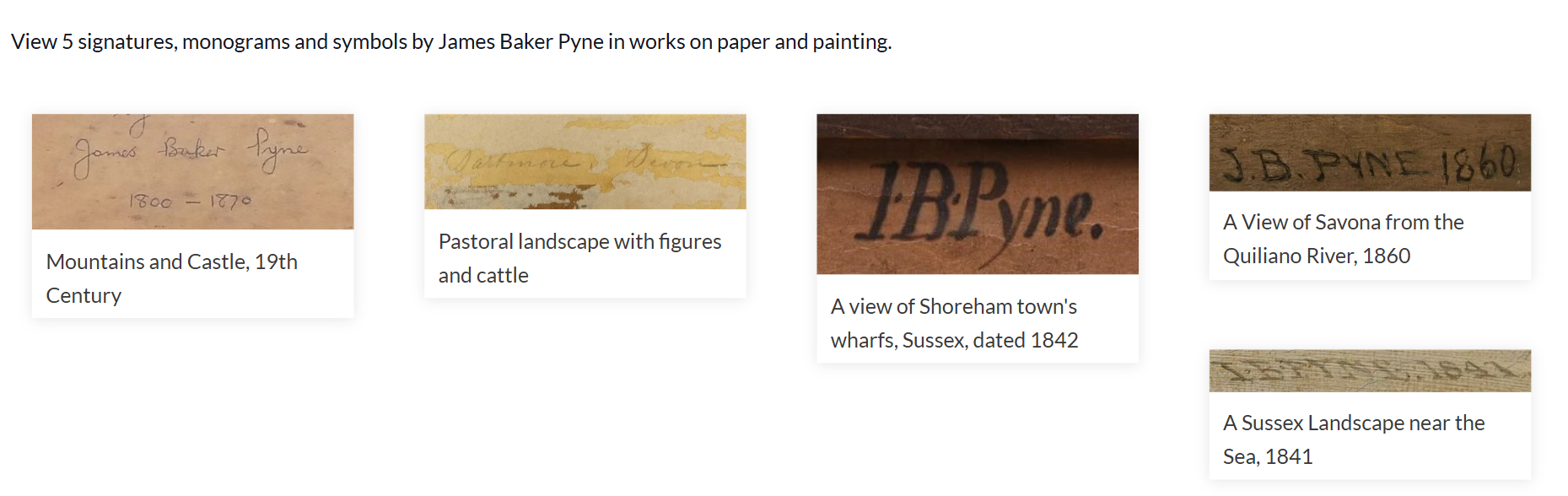
Artist Signature Authentication



The signet visible on the sticker is a stylized monogram—most likely “FR”—indicating the mark of a historical art dealer or publisher specializing in Old and Modern Masters. Although portions of the text are partially obscured, phrases such as “Dealers in Old and Modern Masters” and “Publishers” were commonly used by established galleries and art publishers active in the early to mid-20th century.
Based on the monogram design, typography, and the distinctive green-and-white color scheme, the label closely aligns with those of Frost & Reed, the renowned London-based gallery and print publisher founded in 1808. Frost & Reed was internationally recognized for dealing in Old and Modern Master paintings, publishing high-quality prints, and providing fine art framing. The decorative “F” seen in the logo corresponds with Frost & Reed’s historic branding style.
If confirmed, this association would substantiate provenance through one of Britain’s most respected galleries—further enhancing the artwork’s historical and collectible significance.
Summary: The monogram and label design most likely correspond to Frost & Reed, a distinguished British gallery and publisher known for their expertise in Old and Modern Masters, whose provenance is regarded as a mark of authenticity and prestige in the art market.
ABOUT THE ARTIST
James Baker Pyne (1800–1870)
English Landscape Painter
James Baker Pyne stands as a significant figure in 19th-century British landscape painting, celebrated for his luminous depictions of natural scenery and his mastery of atmospheric effects. Born on December 5, 1800, in Bristol, England, Pyne initially pursued a career in law but abandoned it to follow his passion for art. Largely self-taught, he honed his skills through observation and practice, ultimately becoming a central figure within the Bristol School, a circle of artists devoted to plein-air sketching and poetic interpretations of landscape under the influence of Francis Danby.
In the 1820s, Pyne began exhibiting romantic landscapes that reflected the Bristol School’s emphasis on atmosphere, local scenery, and imaginative composition. His early works showcase his emerging talent for balancing mood, light, and topography. During this period, he collaborated with fellow artists including Edward Villiers Rippingille and mentored pupils such as William James Müller, George Arthur Fripp, and James Astbury Hammersley.
By the mid-1830s, Pyne moved to London, where his style underwent a notable transformation under the influence of J. M. W. Turner. He adopted a broader approach to color, light, and composition, translating Turner’s dramatic and romantic sensibilities into his own distinctive landscapes. During this period, his work demonstrated a skillful handling of luminous skies, expansive vistas, and nuanced tonal transitions, reflecting his evolving style.
Throughout his career, Pyne traveled extensively, painting in the Lake District, Italy, Switzerland, and Germany. His journeys to Italy in the 1840s and 1850s, often alongside the Bristol watercolourist William Evans, produced Italianate landscapes characterized by serene Mediterranean light, architectural detail, and harmonious composition. These travels deepened his understanding of atmosphere and natural grandeur, enriching the emotional and visual impact of his works.
Pyne was a prolific exhibitor, showing at prestigious venues including the Royal Academy, the British Institution, and the Royal West of England Academy in Bristol. He also served as Vice-President of the Society of British Artists, contributing to the development of landscape painting in Britain during the Victorian era. His compositions are noted for their balance, clarity, and romantic sensibility, bridging the poetic imagination of the Bristol School with the dramatic naturalism of Turner.
James Baker Pyne died on July 29, 1870, at his home in Camden Road, London. He left a lasting artistic legacy through both his own work and his pupils, and his paintings remain celebrated for their mastery of light, atmosphere, and compositional harmony. Today, his works are held in major public collections, including Tate Britain, the Victoria and Albert Museum, and the Bristol Museum & Art Gallery, preserving his contribution as a pivotal figure in British landscape painting.