
Tall Tree on Cliff Edge, 1988
Otto Rogers
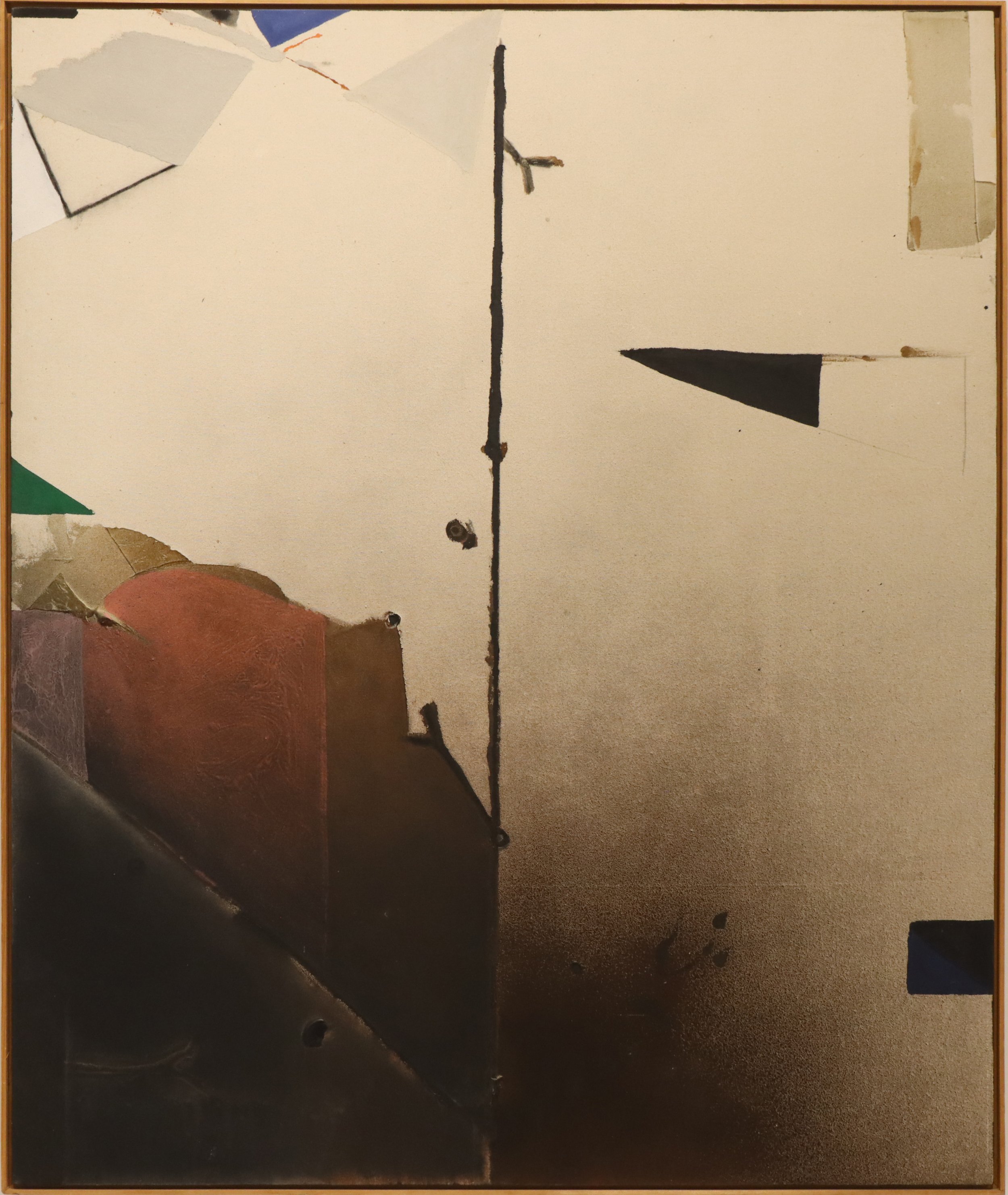

Artist: Otto Rogers
Title: Tall Tree on Cliff Edge, 1988
Media: acrylic on canvas
Size: 72” x 60”
Notes: framed
Provenance:
Mann Collection, St. Catharines since 2017
Artist Douglas Bentham, Saskatoon
Artist’s Studio
Exhibited at The John Mann Gallery, St. Catharines, ON (2019-2025)
Description: Otto Rogers’ Tall Tree on Cliff Edge (1988) is an elegant example of his mastery of lyrical abstraction, blending delicately balanced geometry with earthy, atmospheric textures that evoke both landscape and inner space. Works from this period are increasingly sought after for their refinement, spiritual resonance, and connection to the foundational years of Canadian modernism. This painting carries exceptional provenance: it comes from the respected Mann Collection and was originally acquired directly from artist Douglas Bentham of Saskatoon—himself one of Rogers’ notable students and a respected sculptor in his own right. With its strong lineage, impeccable source, and the continued rise of interest in Rogers’ legacy, this work represents a compelling long-term acquisition for serious collectors.
Collector’s Note: Otto Rogers (1935–2019) stands among Canada’s pivotal modernists, uniting prairie-inflected abstraction with a rigorously balanced, spiritual visual language that continues to resonate with contemporary collectors. With the artist’s passing, the supply of prime works is definitively finite; as curatorial attention and institutional recognition continue to grow, prices are poised to strengthen, particularly for large, resolved canvases from key periods, pieces with strong exhibition provenance, and works that clearly demonstrate his hallmark equilibrium of structure and luminous, atmospheric colour. Current market indicators place many medium-to-large paintings in the high four- to low five‑figure range, with standout examples achieving mid‑five figures at auction, while gallery offerings for museum‑quality works can command higher levels—still compelling relative to his art‑historical importance. For collections focused on Canadian modernism, a thoughtfully selected Rogers offers lasting aesthetic depth, spiritual nuance, and solid long‑term value potential.
ABOUT THE ARTIST
Otto Donald Rogers (1935–2019)
Otto Rogers was a major Canadian modernist painter and sculptor whose work fused the vastness of the prairie landscape with the structural clarity of cubist-constructivist abstraction and a deeply rooted spiritual sensibility. Born in Kerrobert, Saskatchewan and raised on a nearby farm, Rogers grew up surrounded by open horizons, changing skies, and the contemplative quiet of the prairie environment—elements that became the foundation of his mature artistic language. His paintings, with their floating planes, atmospheric fields, and elegantly balanced geometries, echo the expansiveness and stillness of the region that shaped him.
Rogers studied art at the University of Wisconsin–Madison, where he earned a B.Sc. in Art Education in 1958 and an M.Sc. in Fine Art in 1959. During these formative years he received numerous awards and scholarships, held multiple solo exhibitions, and encountered the modernist ideas that would inform his lifelong exploration of space, structure, and unity. He absorbed influences from Picasso, Mondrian, and the European and American modernists, and gradually developed an approach that balanced expressive gesture with architectural clarity.
In 1959, Rogers joined the faculty of the University of Saskatchewan, beginning a nearly three-decade career that left a lasting imprint on Canadian art. As a professor and later Head of the Art Department, he helped shape generations of artists and played a pivotal role in the Emma Lake Artists’ Workshops—an influential program that attracted international figures such as Clement Greenberg, Donald Judd, Anthony Caro, and Kenneth Noland. Rogers was both an ambassador of prairie modernism and a bridge between Canadian abstraction and broader global movements, contributing significantly to the cultural and artistic dialogue of the region.
A devoted member of the Bahá’í Faith, Rogers’s artistic philosophy reflected his belief in harmony, unity, and the spiritual dimensions of human experience. His paintings became meditations on balance—between structure and atmosphere, multiplicity and order, gesture and stillness. Throughout his career he experimented with acrylic, collage, spray techniques, and mixed media on gessoed canvas, layering surfaces with a slow, deliberate approach that allowed his compositions to evolve over long periods.
Rogers’s career included numerous solo and group exhibitions across Canada and abroad. He exhibited at the Glenbow Alberta Institute in Calgary, the Mendel Art Gallery in Saskatoon, the Canadian Cultural Centre in Paris, and Galleria del Milione in Milan, among many others. His works entered major public collections, including the National Gallery of Canada, the Art Gallery of Ontario, the Montreal Museum of Fine Arts, and the Beaverbrook Art Gallery, along with significant corporate and university collections.
In 1988, Rogers left his academic post to serve two consecutive five-year terms at the Bahá’í World Centre in Haifa, Israel, where he was a Counsellor on the International Teaching Centre. This experience deepened the spiritual foundation of his art and worldview. When he returned to Canada in 1998, he and his wife Barbara settled in the quiet community of Milford, Prince Edward County, where he worked in a purpose-built waterfront studio designed by his son-in-law, architect Siamak Hariri. There, overlooking the changing light of Lake Ontario, Rogers continued to refine his vision, producing some of the most serene and distilled works of his career.
Throughout six decades of sustained creative inquiry, Otto Rogers developed a body of work that remains central to the story of Canadian abstraction. As both artist and educator, he shaped the artistic landscape of the Prairies and influenced generations of painters and sculptors. His work, marked by its clarity, balance, and contemplative spirit, stands as a lasting testament to a life devoted to the exploration of form, meaning, and unity.